
Table of Contents (24 sections)
AI Tools for Dropshipping in 2026: A Realistic Stack, Task by Task
Every dropshipping platform now advertises some version of "AI-powered." In practice, that label covers a wide range of very different things: a machine-learning model that scores products by demand, a support chatbot trained on your FAQ, a pricing rule that watches competitors overnight, or plain ChatGPT with a good prompt. None of it runs a store by itself, and treating it that way is the fastest way to pay for a subscription you barely use.
This guide breaks the dropshipping workflow into its component tasks, product research, copywriting, pricing, customer support, marketing, and fulfillment, and looks at which parts a well-configured AI stack can realistically carry in 2026, what the leading tools in each category cost right now, and where a human still has to make the call.
Quick answer
In 2026, AI tools reliably handle the repetitive, rules-based parts of running a dropshipping store: surfacing product and trend signals, drafting a first pass of product or ad copy, adjusting prices against competitor movement, answering routine order-status questions, and triggering marketing emails and texts based on behavior. They do not replace supplier vetting, product-market judgment, or handling an angry customer. A launch-stage store can cover most of this with free tiers for well under $50 a month; a scaling store with real order volume typically spends somewhere in the low hundreds once support and pricing tools are added. Several tools changed their pricing structure in the past year, most notably Tidio splitting its Lyro AI chatbot into a separate add-on, so figures you have seen in older guides may no longer be accurate.
What "AI" actually covers in a dropshipping stack
Three different kinds of tools get marketed under the same "AI" label, and it helps to keep them separate. The first is a scoring or recommendation model, the kind that ranks products by demand and advertising signals, or predicts which subscriber is likely to buy again. The second is a generative language model, used for product descriptions, ad copy, or a support chatbot's replies. The third is simple rules-based automation dressed up as AI, such as a price that updates on a fixed schedule. All three are useful. None of them are a substitute for deciding which products to sell or how to position them, which is still a judgment call a founder has to make.
What AI can and cannot automate for you
AI tools meaningfully reduce manual work in a handful of areas: scanning large volumes of products or ad creatives for demand signals, generating a first draft of repetitive copy, adjusting prices within rules you set, resolving routine "where is my order" or return-policy questions, and sending time-based or behavior-based marketing messages without a person clicking send each time. What it does not do reliably is vet a new supplier, judge whether a product fits your brand, de-escalate a genuinely upset customer, or decide your positioning against competitors. Budget for a real setup period, connecting accounts, writing FAQ content for a chatbot, and testing pricing rules before they run unsupervised, rather than expecting a finished workflow on day one.
The AI stack, task by task
Product and trend research
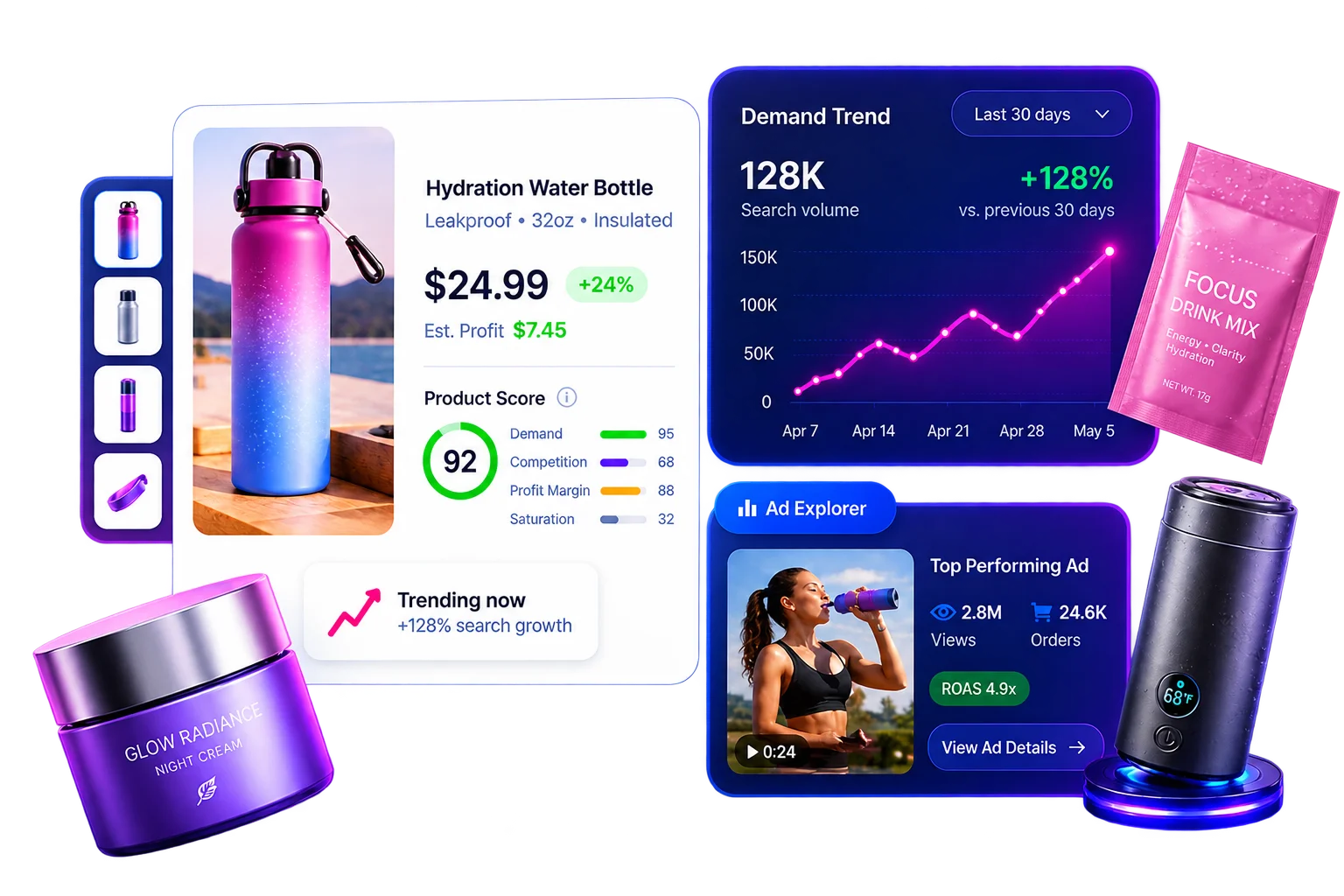
This is the highest-leverage use of AI in dropshipping, and also the one where the underlying data quality matters most. A model that ranks products by demand is only as good as the signals feeding it: sales velocity, ad longevity, search trend direction, and how saturated the competition already looks. Dropmind's Winning Products research surfaces opportunities that meet defined demand and data-quality criteria, and Ads Explorer lets you study how long a competitor's creative has stayed active and how they are positioning it, both useful signals for judging whether demand is durable rather than a short-lived spike. Treat any AI product score as a research shortlist to investigate further, not a guarantee, and pair it with the same demand, margin, and competition checks covered in Dropmind's guide to finding winning dropshipping products.
AI copywriting for product pages and ad copy
Writing unique descriptions for dozens of SKUs by hand is one of the biggest time sinks in dropshipping, and this is where general-purpose language models earn their keep fastest. A reusable prompt that includes your brand voice, the target keyword, and specific product details will produce a usable first draft from ChatGPT or Claude in under a minute, though it still needs a human pass for accuracy and tone before it goes live. Dedicated marketing-copy tools go further for ad creative specifically: as of 2026, Jasper's Creator plan starts at $39 a month for one seat, with Pro running $59 to $69 a seat depending on billing term, and Copy.ai's free plan (2,000 words a month, no card required) is usable for light testing before its $49-a-month Pro tier removes the word cap.
Dynamic pricing and margin protection
Manual pricing means setting a number once and forgetting it. Rule-based pricing tools watch supplier costs and competitor prices continuously and adjust automatically, for example "always price 5% below the lowest competitor" or "hold a fixed margin above supplier cost." Prisync is a common choice for this, tracking competitor prices across thousands of listings; its current plans start at $99 a month for up to 100 tracked products, stepping up to $199 for 1,000 and $399 for 5,000, noticeably higher than the roughly $59 entry price sometimes quoted in older articles. Store platforms with built-in markup rules calculate retail price from supplier cost automatically at import time, which covers a launch-stage store's pricing needs without a separate subscription until competitor-price tracking becomes worth paying for.
AI-powered customer support
Support is where solo dropshippers hit their first real time crunch once orders start arriving. Tidio's Lyro AI bot, trained on your store's FAQ content, can handle order-status checks and basic policy questions, but its pricing changed meaningfully in 2026: the free plan includes a limited lifetime allotment of Lyro conversations, and beyond that, Lyro is now billed as a separate add-on ($39 to $289 a month depending on volume) on top of a base plan (Starter around $29/month, Growth from about $49 to $59/month) rather than bundled in as it once was. Gorgias is built for higher support volume and ties pricing to ticket count rather than seats: plans run from $10/month (50 tickets) up to $900/month (5,000 tickets) on monthly billing, and its AI Agent charges an additional $0.90 to $1.00 per resolved ticket on top of the base ticket fee. Whichever tool you use, set a clear rule for when a conversation escalates to a human. A bot that confidently mishandles a damaged-item complaint does more damage to trust than a slower human reply would.
Marketing automation, email, and SMS
Klaviyo remains the standard email and SMS platform for ecommerce, and its predictive send-time and repeat-purchase features are genuinely useful once a list has enough history to learn from. Its free plan covers up to 250 active profiles and 500 monthly email sends; paid plans start around $20/month at 500 contacts. Since February 2025, Klaviyo bills on active profiles, meaning every contact who could be emailed counts toward your tier whether or not you actually email them that month, which is worth checking before your list grows past a free-tier threshold you weren't tracking. For ad creative specifically, AdCreative.ai generates banner variations from a product image and brand colors; current plans start at $29/month for 10 credits, running up to $249/month for 200 credits with video generation, both noticeably above the roughly $21/month sometimes quoted for entry-level access. Organic short-form content still does the heaviest lifting for cold discovery before any paid creative tool gets involved, a channel-specific breakdown of that side of the stack is in Dropmind's Instagram marketing playbook for dropshipping.
Order and fulfillment automation
The operational side of dropshipping, sending orders to suppliers, syncing tracking numbers, flagging stock or price changes, is exactly the kind of repetitive, rules-based work automation handles well. Shopify and WooCommerce both support native and third-party order-automation apps that route a paid order to a supplier and sync tracking back to the customer without manual input once configured. When evaluating any third-party fulfillment automation tool, confirm it integrates natively with your specific suppliers and sales channels rather than assuming broad compatibility, and keep a manual fallback for orders that fail to sync automatically.
Building your stack by store stage
| Stage | What to add | Approximate monthly cost (2026 pricing) |
|---|---|---|
| Launch (0-10 orders/day) | Platform-native product curation and markup rules, ChatGPT or Claude for copy, a free-tier support chatbot | $0 to $30 |
| Growth (10-50 orders/day) | Klaviyo paid tier, a paid support plan with limited AI conversations, Prisync or platform-native pricing rules | Roughly $150 to $300 |
| Scale (50+ orders/day) | Gorgias with AI Agent resolutions, AdCreative.ai for creative volume, Prisync at a higher product-count tier, Klaviyo at a higher contact tier | Roughly $400 to $800+ |
Treat these as directional ranges, not fixed budgets. Actual cost depends heavily on order volume, list size, and how many tools you stack on top of each other, and every platform listed above changes its pricing periodically. Confirm current numbers on the provider's own pricing page before committing a subscription, especially for tools like Tidio and Gorgias where the AI-specific cost sits on top of the base plan rather than inside it.
Where AI tool pricing shifted the most going into 2026
Two changes are worth flagging specifically because they contradict pricing figures still circulating in older guides. First, Tidio unbundled Lyro AI from its base subscription tiers; a store that budgets $29/month expecting full AI chat coverage will find that Lyro now costs extra past a small free allotment, and getting it fully included requires the $749/month Plus plan. Second, Klaviyo's February 2025 shift to active-profile billing means the free tier's "250 contacts" ceiling is reached faster than store owners expect, since it counts everyone on your list who could be emailed, not just the ones you actually send to. Neither change makes these tools not worth using. Both make it worth re-checking the current pricing page rather than budgeting from a guide, including this one, without confirming the numbers first.
What to avoid when using AI for dropshipping
- Publishing AI-generated product descriptions or ad copy without a human review pass. Raw output often contains generic phrasing or inaccurate specifications that a 60-second edit would catch.
- Over-automating customer support past routine questions. Set a clear rule for when a conversation escalates to a human, especially for damaged items, lost packages, or an already-frustrated customer.
- Relying on AI product scores as a substitute for supplier vetting. Check a supplier's rating and recent reviews and, for a product that will become a core SKU, order a test unit yourself before committing.
- Assuming every AI-branded marketing or review-generation tool is compliant with platform terms of service. Meta, Google, and major review platforms all restrict certain kinds of automated activity, and an account suspension typically costs far more than the tool saved.
- Budgeting from someone else's pricing screenshot. Confirm current tiers on the provider's own site, since several of the tools in this guide changed pricing structure within the past year.
Who should use which tools, and when to add them
Complete beginner
Start with your store platform's built-in product curation and automated markup rules, ChatGPT or Claude for product descriptions, and a free-tier support chatbot. Hold off on paid subscriptions until you have processed your first handful of real orders and know which tasks are actually eating your time, rather than guessing in advance.
Intermediate, part-time store owner
Once you are consistently landing 20 to 50 orders a week, a paid email and SMS platform and a paid support plan typically earn back their cost in saved time. If you are running paid ads, a dedicated ad-copy or creative tool speeds up testing meaningfully at this stage.
Advanced, scaling toward full-time
At 50 or more orders a day, every manual touchpoint becomes a real bottleneck. A ticket-based support platform with AI resolution, competitor-price tracking, and marketing automation at a higher contact tier form a reasonable full stack, generally in the low hundreds to around $800 a month depending on volume. At that order volume, the tool spend is usually a small fraction of revenue, so the more important question is whether each tool is actually reducing your workload, not whether you can afford it.
Frequently asked questions
What is dropshipping AI?
Dropshipping AI refers to artificial intelligence, primarily machine-learning scoring models and generative language models, applied to the repetitive tasks in running a store: product research, pricing, copywriting, customer support, and marketing automation. Most tools connect to a store platform through a standard integration and require no coding.
What are the best AI tools for dropshipping in 2026?
There is no single best tool across every task, since each covers a different job. For product and ad research, Dropmind's Winning Products and Ads Explorer cover demand and creative signals. For copywriting, ChatGPT or Claude handle a first draft, with Jasper or Copy.ai for dedicated ad-copy workflows. For support, Tidio Lyro or Gorgias, depending on ticket volume. For pricing, Prisync or a platform's native markup rules. For retention marketing, Klaviyo.
Can AI fully automate a dropshipping business?
No. AI can automate the majority of routine, rules-based tasks, order-status replies, price adjustments within set rules, scheduled marketing sends, but supplier vetting, product-market judgment, brand positioning, and handling a genuinely upset customer still require a person. Treat AI as removing the repetitive load so you can focus on those higher-judgment decisions, not as replacing them.
How does AI help with dropshipping product research?
AI-assisted research tools analyze demand signals such as sales velocity, ad longevity, and search trend direction across large numbers of products far faster than manual browsing allows. This surfaces candidates worth a closer look, not a finished decision. A product surfaced by any scoring tool still needs the same margin, supplier, and competition checks a manually found product would need before you commit budget to it.
Has AI tool pricing changed much for dropshipping stores in 2026?
Yes, in ways that catch store owners using older guides off guard. Tidio moved its Lyro AI chatbot to a separate add-on rather than bundling it into base plans, and Klaviyo now bills on active profiles rather than emails sent, which reaches its free-tier limit faster than the old model did. Both changes are worth checking directly on the provider's pricing page before budgeting a stack around figures from an article published even a year earlier.
The bottom line
The dropshipping stores getting real value from AI in 2026 are not the ones running every tool in this guide at once. They are the ones that matched a specific tool to a specific bottleneck, product research when manual browsing was too slow, a chatbot when support tickets started piling up, pricing rules when margin was slipping unnoticed, and confirmed current pricing before committing a subscription. Layer tools on as your order volume actually creates the workload that justifies them, and keep a human in the loop wherever a decision needs judgment rather than a rule.