Table of Contents (20 sections)
Amazon Dropshipping in 2026: Is It Still Worth It?
Amazon dropshipping is legal, and it still works in 2026, but the version of it that works looks different from the "list a product and wait for orders" pitch that circulated a few years ago. Enforcement is tighter, the Professional selling plan is effectively mandatory the moment you want to automate anything, and Amazon's own reporting shows third-party sellers shrinking as a share of the platform for the first time since it began disclosing the figure.
None of that makes Amazon a bad channel. It makes it a channel that punishes weak execution faster than it used to. This guide covers what Amazon actually requires, what it actually costs, and how to decide whether the model fits your business right now.
Quick answer
Yes, dropshipping on Amazon is allowed. Amazon's Drop Shipping Policy permits it under specific conditions: you must be the seller of record on every order, your business name (not your supplier's) has to appear on packing slips and invoices, no third-party branding can reach the customer, and you, not your supplier, handle returns. Buying from another online retailer and shipping it directly to an Amazon customer under that retailer's name is a policy violation, not a gray area, and it is the most common reason accounts get suspended. Beyond that quick answer, the rest comes down to execution: fees, account health metrics, and whether your unit economics hold up once Amazon's cut is priced in.
This article reflects Amazon's Seller Central policy pages, referral fee schedule, and Q1 2026 earnings disclosure as reviewed on August 9, 2026. Amazon can update its policies, fees, and performance thresholds at any time, so confirm current wording directly in Seller Central before making a compliance or pricing decision.
What Amazon's dropshipping policy actually requires
Amazon's official Drop Shipping Policy, published in Seller Central, sets four obligations for any seller using a dropshipping model.
- You must have a supplier relationship confirming that you, the Amazon seller, are the seller of record, not a pass-through reseller for a named retailer.
- Your business name, not your supplier's, must appear on every packing slip, invoice, and piece of external packaging the customer sees.
- Any material identifying a different retailer or supplier, including logos, receipts, and promotional inserts, must be removed before the order ships.
- You, not your supplier, are responsible for accepting and processing returns, refunds, and customer communication.
Suppliers are allowed to store, pack, and ship inventory on your behalf. What they cannot do is show up anywhere in the customer's experience. That distinction is why retail arbitrage, buying from a retailer such as Walmart or Target and shipping their box straight to your buyer, is treated differently from working with a dedicated dropshipping or wholesale supplier that ships unbranded. The retailer's name inside the box is the violation, not the fact that you never touched the inventory.
Amazon also expects general compliance with its Seller Code of Conduct, category-specific approval where required (jewelry, supplements, and watches are common gated categories), and listings that accurately match what ships. None of this is unique to dropshipping. It is the same bar every Amazon seller clears, but dropshippers get scrutinized harder because the model has a reputation for cutting corners.
This is general platform-policy information, not legal advice. Amazon's Seller Central pages are the authoritative source and can change; a category approval requirement or a specific fee shown here can move between the time this article was reviewed and the time you read it.
Two shifts worth planning around in 2026
Two changes matter more for planning purposes than most guides mention.
Third-party seller share is shrinking, not growing
According to Amazon's Q1 2026 earnings disclosure, independent sellers accounted for 60% of worldwide paid units, down from 61% in Q4 2025 and 62% the quarter before that. Independent analysis of Amazon's own reporting has described this as the first back-to-back quarterly decline since Amazon began breaking out the figure. The likely driver is Amazon's own expansion into grocery and same-day delivery, which shifts units toward Amazon's first-party sales rather than a drop in third-party demand. The practical takeaway: the opportunity is still large, but it is no longer a rising tide. Growing in a category now means taking share from other sellers more than simply showing up.
The Professional plan is no longer optional if you want to automate
Repricing, inventory-sync, and bulk-listing tools all run through Amazon's Selling Partner API, which is available on the Professional plan only. At $39.99 per month against the Individual plan's $0.99 per item, the breakeven point sits around 40 units a month, but if any part of your workflow depends on automation, you need Professional regardless of volume. Budget for it from the start rather than treating it as a later upgrade.
The real cost math: fees, margin, and a worked example
Amazon's take comes from two places: a selling-plan fee and a referral fee.
The Individual plan costs $0.99 per item sold with no monthly fee. It can work under roughly 40 sales a month, but it excludes advertising, bulk tools, and Featured Offer (Buy Box) eligibility. The Professional plan costs $39.99 per month with no per-item fee, and it unlocks Sponsored Products, bulk listing, and Selling Partner API access. It becomes the cheaper option past about 40 monthly units.
Referral fees run roughly 8% to 15% for most categories, with a $0.30 minimum per item. A small number of categories, including some accessories and specialty goods, run as high as 20% to 45%. Fees are calculated on the full transaction value, including shipping and gift-wrap charges, not just the item price. Check your specific category and price tier in Seller Central before you finalize pricing. That step is where sellers most often lose margin, because they price off the item cost alone.

Here is a worked example using illustrative numbers, not a real listing. Say you sell a kitchen gadget at $34.99 in a category with a 15% referral fee. Amazon takes roughly $5.25 in referral fees. Supplier cost is $16. Shipping to the customer, paid by your supplier and built into your landed cost, runs about $4. That leaves a contribution margin of roughly $9.74, or about 28% of the sale price, before the Professional plan fee, advertising spend, and returns. Building an 18% to 20% fee buffer into every price you set is a reasonable planning habit, since supplier costs and referral tiers can both move and thin margins disappear quickly when either does.
Dropshipping vs. FBA vs. cross-marketplace sourcing
Most sellers land on Amazon dropshipping by process of elimination. It is worth comparing the alternatives directly.
| Model | Upfront capital | Who ships | Featured Offer odds | Best fit |
|---|---|---|---|---|
| Dropshipping | Low. Pay the supplier after the sale. | Your supplier | Lower, depends on shipping speed and account metrics | Testing products with limited capital while managing compliance closely |
| Fulfillment by Amazon (FBA) | High. Buy inventory upfront and pay storage. | Amazon | Higher, Prime eligibility helps | Proven products with available capital who want less day-to-day operational load |
| Cross-marketplace sourcing (for example, Amazon UK to Amazon US) | Low, similar to standard dropshipping | Original marketplace's supplier, repackaged | Same rules apply as any dropshipping setup | Sellers with sourcing relationships in a second Amazon marketplace |
Cross-marketplace sourcing is legal. You can dropship from one Amazon marketplace to another, or from Amazon to your own Amazon store, but the same seller-of-record and unbranded-packaging rules apply. Shipping a UK-sourced item to a US buyer with UK packaging or an Amazon UK invoice inside the box is exactly the kind of violation that gets listings removed, even though the supplier happens to be Amazon itself.
FBA fulfillment fees typically run in the range of $3 to $6 or more per unit for standard-size items, depending on weight and dimensions, on top of storage costs. This range is an approximation; use Amazon's own FBA Revenue Calculator for an exact figure on a specific product before comparing it against dropshipping margins on the same item.
Account health metrics: what actually leads to suspension
Amazon rolls its seller-performance signals into a single Account Health Rating, a 0 to 1,000 score visible on the Account Health dashboard in Seller Central. New accounts start at 200. Scores of 200 or above are generally treated as healthy, scores from 100 to 199 indicate risk of deactivation, and scores below 100 typically mean deactivation has happened or is close. Policy violations deduct points based on severity, and a clean run of fulfilled orders earns points back over time.
Four metrics feed that score and directly affect Featured Offer eligibility.
- Order Defect Rate, which combines negative feedback, A-to-z claims, and chargebacks, needs to stay below 1%.
- Late Shipment Rate needs to stay below 4%, and early warnings often trigger once a seller crosses roughly 3.2%.
- On-Time Delivery Rate needs to stay at or above 90% for seller-fulfilled listings.
- Valid Tracking Rate should stay above 95% for standard sellers; Seller Fulfilled Prime carries a stricter 99% requirement.
None of these thresholds are unusual. They mostly reflect supplier reliability. If a supplier ships late or provides inaccurate tracking data, the account absorbs that damage, not the supplier. That is the real argument for vetting a supplier's handling time and tracking accuracy before listing a single product, rather than after metrics start slipping.
Product research: choosing products worth the compliance overhead
Given how much operational discipline Amazon dropshipping now requires, product selection matters more than it did when the model was more forgiving. Chasing a product with a short shelf life is a weaker trade when a rushed launch means skipping supplier vetting to move fast.
A workable research approach looks at demand signals such as search volume, review velocity, and how long a product's advertising has stayed active; competitive density, meaning how many sellers already hold Featured Offer positioning on that listing or a near-identical one; and supplier reliability, covering handling time, tracking accuracy, and return policy, before margin. Margin comes last in that sequence because a strong margin on a product with an unreliable supplier can turn into no margin at all once a Late Shipment Rate crosses 4%.
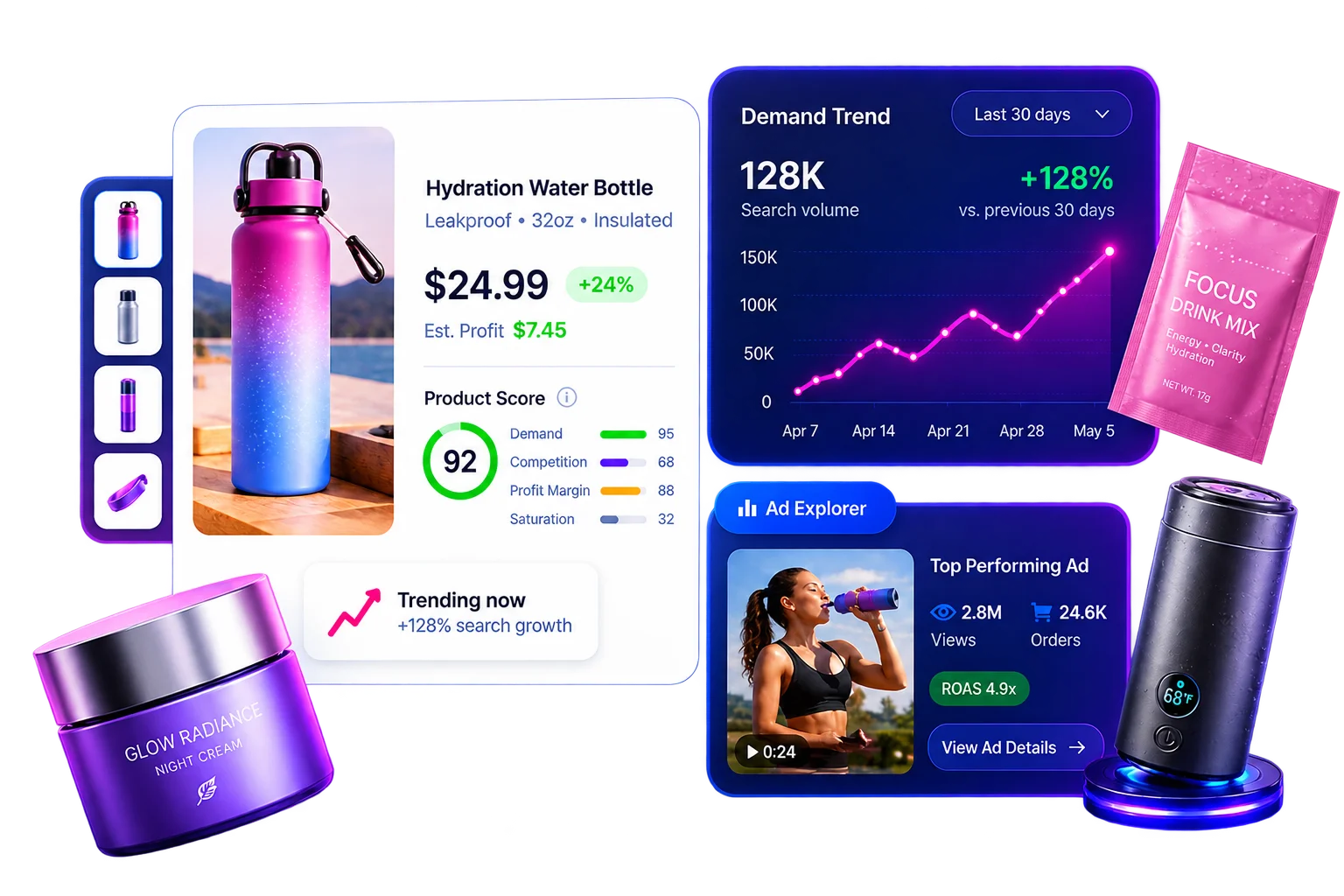
This is the layer where a dedicated research tool can save real time compared with manual scrolling. Dropmind's Winning Products research shortlist and Ads Explorer are built around exactly this kind of evaluation: reviewing how long a product's advertising has stayed active, how many creative variations exist, and what signals support or weaken a given opportunity, alongside an explanation of why a product surfaced rather than a raw list to sort through by hand. A product that has been advertised steadily for months carries a different risk profile than one that spiked last week, and that context is worth checking before committing to sourcing for Amazon specifically. As with any research tool, the output is a starting point for further validation, not a guarantee that a given product will sell.
Launch checklist: the condensed version
Once you have settled on a product, the mechanics are straightforward.
- Register your Amazon Seller Central account and complete identity verification, which typically includes a government ID, bank details, and in some cases a video verification call.
- Choose your selling plan: Individual under roughly 40 units a month, or Professional if you need automation or advertising from day one.
- Confirm category approval where required; jewelry, supplements, and a handful of other categories need it before you can list.
- Set up your supplier relationship and confirm, in writing or in their fulfillment terms, that they ship unbranded with your business name on all customer-facing paperwork.
- Create listings with accurate titles, images, and specifications. Some fields, such as titles and item specifications, need to be edited directly in Seller Central rather than through a third-party tool.
- Price with your full fee stack built in (referral fee, plan cost, and a margin buffer) instead of setting a price first and checking the margin afterward.
- Set up tracking upload and order-status workflows, whether manual or through a third-party automation tool, before your first sale rather than after your Valid Tracking Rate starts slipping.
A fulfillment automation platform can handle the later steps at scale, but none of it substitutes for getting supplier vetting and pricing math right at the start.
Common mistakes that trigger suspensions
- Shipping from a retailer instead of a dedicated supplier remains the single biggest cause of suspension. Walmart or Target packaging inside an Amazon order is a red flag regardless of how well the product sold.
- Pricing off item cost alone, without accounting for the referral fee tier and plan cost, produces margins that look fine on a spreadsheet and lose money in practice.
- Relying on a single supplier with no backup for stockouts or shipping delays turns one bad week for the supplier into a Late Shipment Rate problem for the seller.
- Selling into gated categories without approval, or substituting a retail receipt for a proper distributor invoice, gets listings removed even when the product itself is legitimate.
- Letting Account Health go unchecked between violations means a problem is often discovered only after Featured Offer eligibility, or the account itself, is already gone.
Frequently asked questions
Is Amazon dropshipping legal in 2026?
Yes, provided the seller is the seller of record, their business name appears on all customer-facing paperwork, no third-party branding reaches the buyer, and the seller handles returns directly. Shipping a product from another retailer under that retailer's name is not permitted.
How much does it cost to start dropshipping on Amazon?
Beyond the selling plan ($0.99 per item or $39.99 per month) and referral fees (roughly 8% to 15% for most categories, higher for a few), budget for supplier costs, any advertising, and a cash buffer to cover returns and chargebacks while your account history builds.
Do I need the Professional plan to dropship on Amazon?
Not strictly, but any repricing, bulk-listing, or inventory-automation tool requires Selling Partner API access, which is available on the Professional plan only. If automation is part of the plan at all, budgeting for Professional from the start avoids a mid-course switch.
Is Amazon dropshipping still profitable in 2026?
For sellers who price correctly and manage supplier reliability, many industry estimates suggest net margins in the range of roughly 15% to 25% after fees are realistic, with stronger performers reporting higher figures and newer sellers often reporting lower ones. These are third-party estimates rather than an official Amazon figure, and margins compress quickly for sellers who skip the fee-buffer step or absorb repeated late-shipment penalties.
What is the difference between Amazon dropshipping and FBA?
Dropshipping requires no upfront inventory purchase and carries no storage fees, but compliance requirements are stricter and Featured Offer odds are generally lower. FBA requires buying inventory ahead of sales and paying storage and fulfillment fees, but it usually has an easier path to the Featured Offer because of Prime eligibility and faster delivery.
Can I dropship from one Amazon marketplace to another?
Yes. Sourcing from Amazon UK to sell on Amazon US, for example, is allowed. The same seller-of-record and unbranded-packaging rules apply, so shipping with the original marketplace's packaging or invoice is a policy violation regardless of the supplier being Amazon itself.
What happens if I violate Amazon's dropshipping policy?
Consequences range from listing removal to full account suspension, which freezes existing funds and inventory. Repeated or serious violations can lead to permanent deactivation.
Conclusion
Amazon dropshipping in 2026 rewards sellers who treat it as an operations problem rather than a listing problem. The policy is clear, the fees are predictable once they are built into pricing from the start, and the account health metrics are mostly supplier reliability made visible. Sellers who are struggling right now are often still running an older playbook: thin margins, a single supplier, and no buffer for a bad week, on a platform where third-party sellers are, for the first time, losing share rather than gaining it. Getting the fee math and supplier vetting right before scaling still leaves real room for the model to work.
This article is provided for general educational purposes and may not reflect the most current version of Amazon's policies, fees, or performance thresholds. Confirm specifics in Seller Central, and consider consulting a qualified professional for advice specific to your business.