Table of Contents (22 sections)
How to Find Winning Dropshipping Products: A Research-Based Framework for 2026

By the time a product shows up on a "top trending products" list, a lot of other sellers have already seen the same list. The gap between spotting a product and testing it profitably usually isn't about finding a secret source nobody else knows. It's about how carefully you evaluate a candidate before you commit a test budget to it.
This guide walks through where to look for product candidates, what actually separates a promising one from a passing trend, and a six-signal framework you can apply to any product before you build a listing or spend a dollar on ads. None of this guarantees a result. It gives you more evidence to work from than a view count or a gut feeling.
Quick answer
A winning dropshipping product is one with real, verifiable demand, a manageable competitive landscape, enough margin to survive marketing and returns, and evidence that other sellers are actively (and repeatedly) advertising it. No single metric proves any of that on its own. The reliable approach is to pull candidates from several independent sources, then check each one against demand, lifecycle stage, advertising activity, competition, margin, and how much you can actually trust the data behind it, before deciding whether it deserves a test.
What "winning" actually means (and what it doesn't)
A winning product doesn't have to be new, viral, or flashy. Plenty of steady dropshipping sellers build their catalog around unglamorous items that solve a specific, recognizable problem well. What makes a product "winning" is that it consistently converts a reasonable share of the people who see it, at a price that leaves room for marketing costs and still turns a profit.
Viral attention and sales are related, but they're not the same thing. A product can rack up views for a week and disappear from relevance just as fast, especially if the appeal was the video itself rather than the product. Before you treat any signal as proof of demand, it helps to know whether that signal tends to hold up over time or tends to spike and fade. That distinction runs through everything else in this guide.
Where to look for product candidates
The mistake worth avoiding here isn't picking the wrong tool. It's relying on just one. A product that shows up in a marketplace bestseller list, has multiple advertisers actively running creative for it, and shows a stable (not just spiking) search trend is a stronger candidate than one that only shows up in a single place.
The table below covers six independent, non-overlapping sources worth checking regularly. None of them will hand you a finished decision. Each one is useful for a different part of the picture.
| Source | What it shows well | What it can't tell you |
|---|---|---|
| TikTok Creative Center (Top Products) | Products currently featured in high-performing TikTok ads, browsable by region and category, with linked ad examples[1] | Whether the product converts once someone lands on a store, or whether the trend has already peaked |
| Meta Ad Library (Facebook Ad Library) | Every active ad an advertiser is running, including how long it's been live, useful because advertisers rarely keep funding creative that loses money[2] | The advertiser's actual sales volume or profit; ad longevity is a signal, not proof |
| Amazon Best Sellers / Movers & Shakers | Categories and products with consistent, currently updating demand across a huge buyer base | Whether a product suits paid social marketing, or whether it will ship and convert well from a smaller store |
| AliExpress trending and order-growth data | Which products are gaining order volume quickly, which can be a stronger signal than raw order totals for products that are already mature | Supplier reliability, actual retail-level demand outside the marketplace, or Western market fit |
| Pinterest Trends | Longer-lead-time interest in home, beauty, wellness, and gift categories, often before a product shows up elsewhere | Purchase intent; Pinterest users browse well ahead of buying |
| Google Trends | Whether search interest in a product or its close alternatives is rising, flat, or fading over time | Volume in absolute terms; it only shows relative interest, not unit sales |
A few of these deserve a specific habit. On Pinterest, look at categories rather than single products; a rising interest in a broader theme (a type of home organization, a wellness routine) often points toward several sourceable products rather than just one. On Google Trends, compare a candidate against two or three close alternatives rather than checking it in isolation; a steady upward line is a more useful signal than a single spike, which is just as likely to fade as it is to keep climbing.
Categories worth watching in 2026
Some categories consistently produce more workable candidates than others, mostly because they align with ongoing, non-seasonal demand and typically support the kind of margin that survives paid testing. None of these guarantee a winning product; they're a reasonable place to start looking, not a shortcut past the evaluation framework below.
| Category | Why it tends to hold up | Differentiation angle to look for | One caution |
|---|---|---|---|
| Home and cleaning gadgets | Broad audience, easy to demonstrate before-and-after results in short video | Faster charge time, quieter operation, easier-to-clean design | Often heavily saturated; differentiation matters more than the base product |
| Pet care | Pet owners spend consistently on comfort and convenience items | Bundling with a consumable (filters, refills) for repeat purchases | Anything with a motor or moving part needs real supplier quality checks |
| Beauty and personal-care tools | Frequent repeat purchase, strong short-form video fit | A specific use case (travel size, sensitive skin, a faster routine) rather than a generic claim | Skin- and body-contact products draw more scrutiny on quality and returns |
| Fitness and recovery | Steady, largely non-seasonal interest | Portability or a specific use moment (desk break, travel, post-workout) | Crowded category; weak differentiation shows up fast in ad costs |
| Car and mobile accessories | Solves small, recurring frustrations; easy to demonstrate | Compatibility clarity (device types, vehicle types) and build quality | Return rates rise quickly if fit or durability claims overpromise |
| Smart home and lighting | Visual appeal translates well to video; growing baseline adoption | A clear "wow" moment in the first three seconds of a demo | Battery, Wi-Fi, or app-pairing products add support burden |
| Desk and work-from-home | Practical, low emotional risk, easy to justify as a purchase | Solving a specific ergonomic or clutter problem, not just "looks nice on a desk" | Shipping cost and damage risk rise with bulkier items |
| Reusable and low-waste goods | Consistent interest, especially among younger shoppers | Genuine functional improvement over a disposable alternative, not just "eco" branding | Claims about sustainability need to be accurate, not just marketing language |
The six-signal framework for evaluating any candidate
Once you have a shortlist, the question changes from "is this trending" to "does this hold up when I look closely." The six signals below cover the areas that matter most, in roughly the order it makes sense to check them. Treat each one as evidence, not proof. A product that looks strong on five signals and weak on one is a more honest picture than a product judged on a single number.

1. Demand
Start by checking whether interest is real and where it's coming from. Search for the product (and close variations of its name) across the sources above, and look for agreement across independent sources rather than volume in any one place. Comments and reviews are often more informative than view counts: a comment asking "where do I get this" is a stronger buying signal than a like.
2. Lifecycle stage
Every product research decision changes depending on where a product sits in its lifecycle:
- Early: limited advertising history and few established competitors, which also means there isn't much evidence yet either way
- Growing: advertising activity and creative testing are increasing, and more sellers are entering, but there's still room
- Mature: demand is established, competition is real, and offers are more refined; winning here usually requires a genuine differentiation angle
- Saturated: many nearly identical stores and ads are chasing the same customers; still possible to compete, but the execution bar is much higher
- Declining: engagement is falling, fewer advertisers are active, and the product is often past a seasonal window
Knowing which stage a candidate is in changes what you should expect from it. A saturated product isn't automatically a bad choice, but it needs a real angle, not just a copy of what everyone else is running.

3. Advertising activity and creative diversity
Ongoing ad activity is a useful signal because advertisers rarely keep paying for creative that consistently loses money. Check the Meta Ad Library and TikTok Creative Center for the candidate: how long have ads been running, and how many different creative variations exist? Multiple advertisers testing multiple angles over several weeks suggests real, ongoing validation. A single new ad from one advertiser tells you very little yet, in either direction.
If you want to study how a specific product is currently being positioned, you can study active ads to see creative longevity, variation, and the landing pages advertisers are sending traffic to, rather than only guessing from what shows up in your own feed.
4. Competition and differentiation
Competition isn't automatically disqualifying. The real question is whether you can identify a specific way to differentiate: a quieter design, a bundle, a stronger guarantee, better photography, or an audience angle competitors aren't using. If a dozen stores are running the exact same product with the exact same supplier photos, you're competing on price by default, and price-only competition is a hard way to build margin.
5. Margin, worked through real numbers
This is where a lot of otherwise-promising products quietly fail. Revenue means little once supplier cost, shipping, duties, payment processing, and marketing all take their share. Below is a full worked example using a magnetic, wireless-charging car phone mount priced at $34.99.

| Line item | Amount | Note |
|---|---|---|
| Selling price | $34.99 | Reference price for this example |
| Supplier / product cost | $9.50 | Quoted landed unit cost from supplier |
| Shipping to a US address | $3.20 | Confirmed real transit cost, not an optimistic estimate |
| Import duty (illustrative) | $0.95 | Example only; actual duty depends on the product's HTS classification and country of origin |
| Payment processing | $1.32 | 2.9% + $0.30, a typical published card-processing rate[3] |
| Refund and return reserve | $1.75 | 5% of revenue set aside for expected returns |
| Advertising cost per sale (target) | $9.00 | Planning estimate based on category and price point |
| Contribution margin | $9.27 | About 26% of the selling price |
The duty line matters more now than it did a few years ago. The United States suspended duty-free treatment for low-value shipments (previously exempt under $800) for all countries effective August 29, 2025, and CBP has since made that suspension indefinite by regulation.[4] Non-postal, low-value shipments generally require a formal customs entry and are subject to standard duty rates, including any applicable additional tariffs tied to the product's classification and country of origin.[4] Duty rates vary too much by product and origin to generalize into a single number, so treat the $0.95 above as illustrative, and confirm the actual applicable rate for your specific product and sourcing country before finalizing a price. This is general information, not customs, tax, or legal advice; consider a qualified professional for guidance specific to your sourcing arrangement.
A product only clears this signal if the contribution margin, after every line above, still leaves enough room to fund a real testing budget and absorb a slower week without threatening the business.
6. Data confidence
The last signal is really about the other five: how much do you actually trust the evidence you've gathered? A product that looks strong based on one ad you noticed and one Google Trends chart deserves more caution than a product with the same apparent strength backed by multiple advertisers, consistent search interest over several weeks, and marketplace bestseller placement that's held steady rather than spiked once. Treat a promising signal built on thin data differently than the same signal built on several independent, consistent sources. This is a step most product research guides skip entirely, and it's often the difference between a product that tests well and one that looked good on paper.
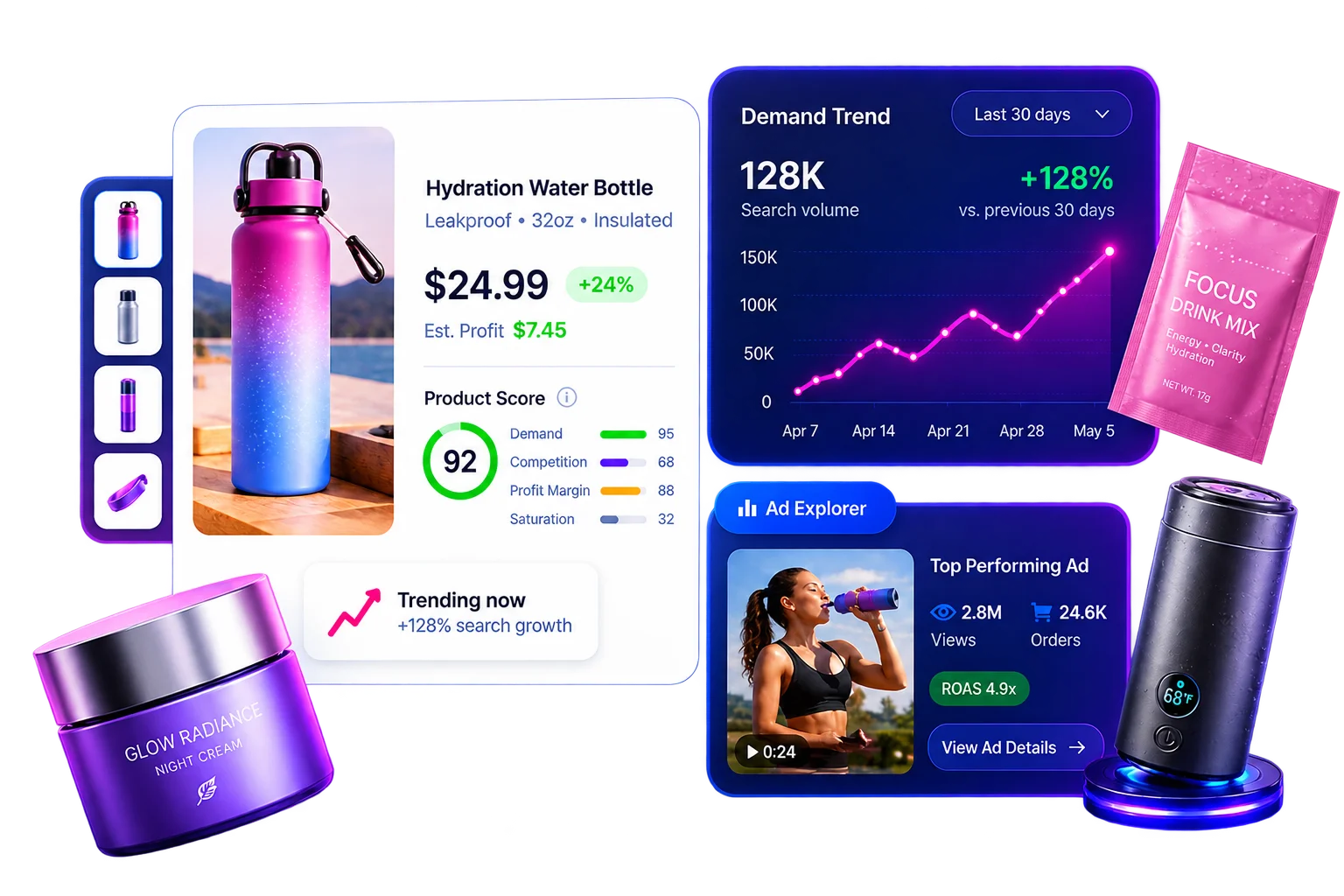
Manually pulling all six signals together for every candidate is real work, which is the specific problem Dropmind's Winning Products research is built to speed up: it organizes advertising activity, product signals, lifecycle stage, and a confidence score into one workflow instead of a dozen open browser tabs. It doesn't replace the judgment calls above. It just gets you to them faster.
Common mistakes when choosing dropshipping products
- Deciding on one signal. A high view count or a single long-running ad is evidence, not proof. Weigh it against the other five signals before committing a budget.
- Chasing a trend after it's already crowded. By the time a product appears on multiple "trending now" roundups, a meaningful share of the easy opportunity may already be gone.
- Ignoring the landed-cost update. Pricing a product as if small international shipments are still duty-free is an easy way to overestimate margin under the current rules.[4]
- Skipping supplier vetting to save time. A single bad batch or a slow shipping time can undo weeks of marketing work; order a sample and check reviews for quality and delivery complaints before scaling.
- Copying the ad instead of the strategy. Reusing a competitor's exact creative and claims invites both a weak-performing ad and potential platform policy issues; use competitor research to understand angles, not to copy them directly.
- Testing one product at a time, slowly. Sellers who test several reasonable candidates in a structured way tend to find a working product faster than sellers who over-invest in a single "perfect" pick before any real data exists.
- Treating margin as a single number. A margin calculated only from supplier cost and sale price, without shipping, duty, processing, and a return reserve, is not a real margin. It's a guess with a decimal point.
Frequently asked questions
Are TikTok-trending products good candidates for dropshipping?
They can be, but a high view count alone isn't validation. Check the product against the other signals, especially advertising activity and lifecycle stage, before treating a viral moment as proof of a sustainable opportunity.
How many products should I test before I expect to find a winner?
There's no fixed number that applies across every niche and price point. Most sellers who build a consistent process test several reasonable candidates rather than pinning everything on one pick, and treat a slow first few tests as normal rather than a signal to stop.
Can a product that's already selling well become saturated?
Yes. As more sellers enter a market, competition typically increases and margins often compress. Products move through lifecycle stages, and a mature product today can look saturated within a few months if enough sellers copy the same offer.
Do I need paid research tools to find winning products?
No. Google Trends, TikTok Creative Center, Meta Ad Library, Amazon Best Sellers, AliExpress, and Pinterest Trends are all free and cover most of the demand and advertising-activity signals in this guide. Paid research platforms mainly save time by combining those signals in one place rather than revealing something the free tools can't show at all.
Does the de minimis change affect every dropshipping product?
It mainly affects low-value shipments sourced from overseas suppliers that previously relied on duty-free treatment under $800. The exact duty impact depends on the product's classification and country of origin, so it's worth checking before finalizing pricing rather than assuming the old duty-free math still applies.[4]
How fast should I scale a product once it starts working?
Scale based on data, not excitement. Once a product shows consistent, profitable results at your tested budget, increase spend gradually while continuing to track cost per result against your break-even number from the margin calculation above.
Build a repeatable research habit
The sellers who consistently find workable products aren't the ones with a lucky pick. They're the ones who run this process on a schedule: a fixed block of time each week checking research sources, a running shortlist instead of a single candidate at a time, and a habit of revisiting a product's lifecycle stage before deciding whether to keep testing, scale, or move on. Individual products come and go. A process you actually repeat keeps producing new candidates long after this week's trending list is irrelevant.
Conclusion
A winning dropshipping product isn't found by copying whatever tops a trending list this week. It's found by pulling candidates from a few independent sources, then checking each one against demand, lifecycle stage, advertising activity, competition, real margin, and how much you can trust the evidence behind it. None of that removes risk entirely, but it replaces a lot of guessing with evidence you can actually defend before you spend a test budget. Start with the framework above, run the numbers honestly, and review the signals behind a product before deciding it deserves a place in your store.
Sources
- [1] Top Products. TikTok Ads Help Center. https://ads.tiktok.com/help/article/top-products. Accessed August 7, 2026.
- [2] Ad Library. Meta. https://www.facebook.com/ads/library. Accessed August 7, 2026.
- [3] Shopify Pricing. Shopify. https://www.shopify.com/pricing. Accessed August 7, 2026.
- [4] U.S. Ends De Minimis Exemption. GHY International. https://www.ghy.com/trade-compliance/us-to-end-de-minimis-exemption-for-low-value-imports-on-august-29/. Published July 30, 2025; updated February 10, 2026. Accessed August 7, 2026. Supporting regulatory reference: U.S. Customs and Border Protection, E-Commerce. https://www.cbp.gov/trade/basic-import-export/e-commerce. Accessed August 7, 2026.
- [5] 2026 social media ecommerce trends and statistics. Sprout Social. https://sproutsocial.com/insights/ecommerce-trends/. Published April 1, 2026. Accessed August 7, 2026. (Citing Hostinger consumer survey data and eMarketer social commerce estimates.)
This information is provided for general educational purposes and may not apply to every business, product, or jurisdiction. Consider consulting a qualified customs, tax, or legal professional for guidance specific to your sourcing and pricing decisions. Dropmind provides research tools and informational signals; product and advertising signals do not guarantee sales or profitability.