Table of Contents (31 sections)
How to Start Dropshipping on eBay: A Compliance-First Guide for 2026

Most guides to eBay dropshipping lead with the upside: no inventory, low startup cost, and access to one of the largest marketplaces in the world. All of that is real. What most guides underplay is that eBay enforces a narrower, more specific dropshipping policy than platforms like Shopify, and it evaluates seller performance against numeric thresholds that can quietly limit your account before you notice anything is wrong.
This guide treats that reality as the starting point rather than a footnote. Below is a complete path from opening an account to running a compliant, reasonably profitable eBay dropshipping business: what eBay actually allows, what it costs using eBay's current published fees, how to check whether a product is worth listing, and how to keep your seller standing healthy while you scale.
Quick answer
Dropshipping is allowed on eBay only when you fulfill orders from a wholesale supplier. Buying an item from another retailer or marketplace and having it shipped straight to your eBay buyer is against eBay's policy and can get listings removed or an account suspended. Beyond that rule, starting is straightforward: register a personal or business account, list your first few items manually and slowly, validate any product against real demand and margin evidence rather than a single signal, price using eBay's actual final value fee structure, and build your seller standards deliberately from your first sale, since eBay's performance thresholds directly affect your fees, visibility, and selling limits.
How eBay dropshipping actually works, and how it's different from Shopify
In a dropshipping arrangement, you list and sell a product without holding inventory yourself. When an order comes in, you purchase the item from a supplier who ships it directly to your customer. Your margin is whatever is left after the supplier's cost, eBay's fees, and any advertising or promotion costs.
The mechanics are similar to dropshipping on Shopify or any other channel. What's different is where the product actually comes from. Shopify is a blank storefront: you decide how you source, and the platform doesn't police the relationship between you and your supplier. eBay does. Its policy specifically permits sourcing from a wholesale supplier and specifically prohibits sourcing by purchasing from another retailer or marketplace for direct shipment to the buyer.[1] That single rule shapes almost every other decision in this guide, from which suppliers are usable to how you should think about product research.
eBay also brings its own audience instead of requiring you to build one from scratch. eBay Inc. reported 136 million active buyers globally in the second quarter of 2026, with US active buyer growth outpacing the total.[2] That existing demand is genuinely useful, but it also means you're competing directly against other sellers on the same search results page for the same items, often with very similar photos and descriptions, which changes how much differentiation actually matters.
You're also not limited to a single storefront. eBay operates separate regional sites, including ebay.co.uk, ebay.de, and ebay.com.au, and eBay International Shipping, eBay's own program for cross-border orders, lets a seller ship an eligible international order to a domestic hub and let eBay handle the rest of the journey, rather than managing customs paperwork yourself for every order.[10] It's worth knowing this option exists once you're past your first few domestic sales, even if it isn't the first thing to set up.
Is eBay dropshipping allowed? The rule that decides everything else
eBay's own help documentation states it plainly: dropshipping, where you fulfill orders directly from a wholesale supplier, is allowed. Listing an item and then purchasing it from another retailer or marketplace that ships directly to your customer is not allowed.[1]
In practice, that means:
- Allowed: buying a product from a wholesale distributor or manufacturer you have a sourcing relationship with, then listing it on eBay at a markup and having that supplier ship it to your buyer.
- Not allowed: listing a product you don't own, then, once it sells, buying that same item from Amazon, Walmart, or another retail storefront and having it shipped directly to your eBay customer.
The second pattern is sometimes called retail arbitrage dropshipping, and it's the version of the model that most frequently triggers account action, because it's also the version most likely to expose the buyer to a packing slip, invoice, or return address from a retailer they never ordered from. Regardless of how you source, you remain responsible for on-time delivery and buyer satisfaction; eBay does not treat "my supplier was slow" as a reason a late-shipment or defect count shouldn't apply to your account.[1][3]

If you're not sure whether a specific sourcing arrangement counts as wholesale, a reasonable test is whether you have an actual account or agreement with the supplier as a reseller, separate from simply having a customer account on a retail website. When in doubt, treat "would this look like a normal wholesale relationship to eBay" as the question to answer before you list, not after a case gets opened.
What it actually costs to dropship on eBay
eBay's fee structure has two layers: an optional Store subscription, and per-listing insertion and final value fees that apply whether or not you have a Store.
Without a Store subscription
Every seller, Store or not, gets up to 250 zero-insertion-fee listings per month. After that allowance, insertion fees run $0.35 per listing in most categories, charged whether or not the item sells.[4] When an item does sell, eBay charges one final value fee, calculated as a percentage of the total sale amount (item price, handling, most shipping charges, and any sales tax collected) plus a fixed per-order fee: $0.30 for orders of $10 or less, $0.40 for orders over $10.[4] For most categories, that percentage is 13.6% of the sale up to $7,500, dropping to 2.35% on any amount above that.[4] A handful of categories, like books, media, jewelry, and trading cards, use different published rates.
With a Store subscription
A Store subscription buys you a larger monthly allotment of zero-insertion-fee listings and a lower final value fee percentage in most categories. Current published tiers, at monthly and annual renewal pricing, are shown below.[5]
| Store tier | Monthly renewal | Annual renewal | Zero insertion-fee listings (fixed price) | Additional listing fee | Most-category final value fee |
|---|---|---|---|---|---|
| No Store | N/A | N/A | 250/month | $0.35 | 13.6% up to $7,500 |
| Starter | $7.95 | $4.95 | 250/month | $0.30 | 13.6% up to $7,500 |
| Basic | $27.95 | $21.95 | 1,000/month | $0.25 | 12.7% up to $2,500 |
| Premium | $74.95 | $59.95 | 10,000/month | $0.10 | 12.7% up to $2,500 |
| Anchor | $349.95 | $299.95 | 25,000/month | $0.05 | 12.7% up to $2,500 |
| Enterprise | Not available monthly | $2,999.95 | 100,000/month | $0.05 | 12.7% up to $2,500 |
One detail worth knowing: eBay's final value fee already accounts for payment processing. Unlike Shopify, where you separately budget for a card-processing rate, eBay's published percentage is the full cost of the sale on their side; there's no separate payment gateway fee to add on top.[4] Because eBay also collects and remits sales tax directly in most states as the marketplace facilitator, that tax amount is typically included in the total the final value fee is calculated on, even though the tax itself passes through to the state rather than staying with you. It's a small amount, but it's worth building into your price expectations rather than discovering it on your first payout statement.
A worked margin example
The table below walks through a hypothetical $39.99 item on a Basic Store subscription, using eBay's current published rates rather than a rough estimate.

| Line item | Amount | Note |
|---|---|---|
| Selling price | $39.99 | Reference price for this example |
| Supplier / wholesale cost | $14.00 | Illustrative landed unit cost |
| Shipping to buyer (seller-paid, folded into listing as free shipping) | $5.50 | Illustrative real shipping cost, not an optimistic guess |
| Final value fee | $5.48 | Basic Store rate: 12.7% of $39.99, plus the $0.40 per-order fee |
| Promoted Listings cost (illustrative) | $2.00 | Planning estimate for a modest ad-rate campaign |
| Return and refund reserve | $2.00 | 5% of selling price set aside for expected returns |
| Contribution margin | $11.01 | About 28% of the selling price |
That contribution margin is what's left to cover your Store subscription cost, any other software, and actual profit. It only holds up if the supplier cost and shipping figures are real numbers you've confirmed, not the supplier's optimistic quote. Run this same math with your real numbers before you commit to a price, not after a few weeks of sales.
Step-by-step: setting up and running an eBay dropshipping account
Step 1. Register and choose personal or business
Go to eBay's registration page and choose between a personal account and a business account. A personal account asks for your name, address, date of birth, and Social Security number if you're in the US; a business account asks for your business name, registered address, phone number, and tax information. Most beginners start with a personal account and can add a business registration later once the store has real transaction volume, since switching account types is a normal, supported change rather than a one-time decision you're locked into.
Common beginner mistake: treating the account type choice as permanent. It isn't. Pick whichever fits your current situation and revisit it as the business grows.
Step 2. Understand your selling limits, and start slow
New eBay accounts operate under a selling limit, a cap on how many items and how much total value you can list per month. eBay doesn't publish a single universal starting number on its public help pages; the limit is personalized and shown in Seller Hub once you're signed in, and it's reviewed and adjusted monthly based on your sales volume and buyer feedback.[6] Widely reported guidance from experienced sellers puts a typical new-account starting limit around 10 items or $500 in total value, though you should treat that as commonly reported rather than officially guaranteed, and check your own dashboard for the number that actually applies to you.
This is also why listing a handful of items slowly (a few every day or two, rather than dozens at once) tends to work better for a brand-new account than an aggressive bulk upload. eBay is watching new accounts more closely in the first stretch, and a sudden spike in listing volume is a common trigger for manual review.
Common beginner mistake: importing a large product catalog on day one, then wondering why listings are getting held or the account gets flagged for review.
Step 3. Check a product before you list it, not after
Generic advice to "check what's trending" undersells how much a bad product choice costs you once you've already committed test budget to it. Before listing anything, work through a short, repeatable check:
- eBay-specific demand evidence. Use eBay's own Best Selling Categories and, if you have Store access, Terapeak's sold-listing and pricing data to see whether similar items have actually sold recently on eBay itself, not just performed well in a TikTok video. A product with no completed-sale history on eBay is a bigger unknown than one with a consistent recent sales pattern.
- Competition density. Search the exact product on eBay and count how many other active listings exist, and how tightly clustered the prices are. A dozen nearly identical listings at nearly identical prices means you're competing mostly on price, which is a difficult position for a dropshipper without a wholesale-cost advantage.
- Real margin, not list-price markup. Run the fee math from the worked example above using the actual wholesale cost and shipping time you've confirmed with the supplier, not the number on their landing page.
- Supplier legitimacy and speed. Confirm the supplier is a genuine wholesale source (see Step 5) and can realistically ship within a handling time you're comfortable listing.
- Compliance risk. Check the product category and any branding against eBay's prohibited and restricted items policy and the VeRO program before you commit to it (see Step 4).
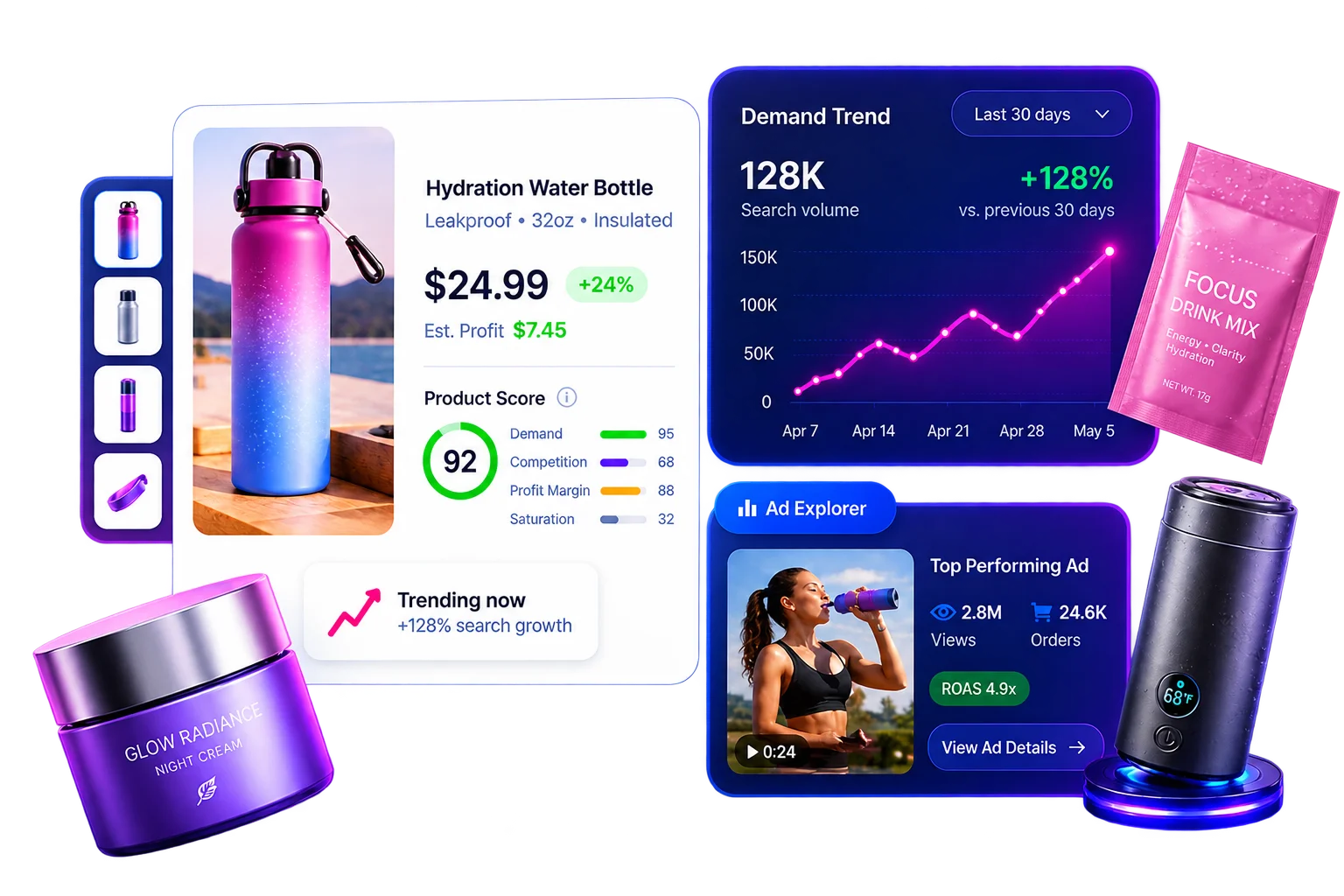
A product that clears all five checks is still not a guaranteed seller. It's a candidate that's earned a real test, instead of a guess dressed up as a decision. If you want a deeper, structured framework for evaluating demand, lifecycle stage, and advertising signals across any channel, not just eBay, Dropmind's Winning Products research organizes those signals into one workflow instead of a dozen open browser tabs, and you can study active ads for a candidate to see how other sellers are already positioning it before you decide whether it deserves a place in your eBay catalog.
Step 4. Know what you can't list
Every marketplace restricts certain categories, and eBay is no exception. Its prohibited and restricted items policy rules out categories including weapons and ammunition, most drugs and drug-related items, alcohol and tobacco in most circumstances, and various hazardous materials, among others.[7] Beyond outright prohibitions, eBay's Verified Rights Owner (VeRO) program allows intellectual-property rights holders to report listings that infringe their trademarks, copyrights, patents, or design rights; eBay reviews each report and removes qualifying listings, and repeated violations can lead to account suspension.[8]
For a dropshipper, VeRO risk usually shows up as an innocent-looking product photo or description that happens to use a brand name, logo, or protected design the seller doesn't have rights to use. Before listing anything with visible branding, ask whether you have an actual right to sell that brand, not just physical access to a product that carries its logo.
Common beginner mistake: assuming that if a supplier is willing to ship a branded item, it must be fine to resell. Supplier willingness and IP rights are two separate questions.
Step 5. Choose and vet a wholesale supplier
Since eBay's policy specifically requires a wholesale sourcing relationship, supplier vetting is not optional homework. It's a compliance requirement as much as a quality one. Look for:
- A genuine wholesale or reseller relationship, not just a retail customer account on a consumer marketplace
- Realistic, confirmed processing and shipping times to US addresses, not a best-case estimate
- Trackable shipping by default
- A clear return and replacement policy toward you, since you can't promise your buyer more than your supplier can support
- Responsive communication before you commit to more than a sample order
- Packaging and paperwork that don't reveal a third-party retailer's branding or invoices to your buyer
Order at least one sample yourself before listing at real volume. A product photo and a glowing review tell you less than holding the actual item and checking how it arrives.
Step 6. List and optimize your first items
List your first few items manually rather than through a bulk-import tool, both because your new-account selling limit makes bulk listing impractical at first and because a manual pass forces you to actually look at each listing before it goes live. A credible eBay listing needs a clear, keyword-relevant title written in the buyer's terms, multiple real product photos rather than a single low-resolution supplier image, an accurate, specific description, and shipping and return terms that match what you actually confirmed with your supplier in Step 5.
Common beginner mistake: copying the supplier's stock title and description verbatim. It's usually generic, occasionally inaccurate, and identical to what other sellers offering the same item are already using, which does nothing to help your listing stand out in search or Best Match ranking.
Step 7. Price using your real fee stack
Take the worked example from earlier in this guide and rebuild it with your actual numbers: real supplier cost, real shipping cost, your actual Store tier's final value fee percentage, a realistic promotion budget if you plan to use Promoted Listings, and a return reserve appropriate to your category's typical return rate. If the resulting contribution margin doesn't leave enough room to survive a slow week or an unexpected return, the price needs to change before you list, not after your first disappointing month.
Step 8. Fulfill orders and handle cases and returns
Whether you place each order with your supplier manually or use a general-purpose order-automation tool, the standard is the same: process orders promptly, and get tracking information into the eBay order record as soon as it's available. Tracking matters more than it might seem: it directly affects whether a shipment counts as late and whether you're eligible for eBay's protections if a buyer later claims an item never arrived.[3]
When a case or return does come in, respond quickly and resolve it directly with the buyer where possible. A case that eBay has to step in and decide against you counts against your seller standards (see Step 9). Proactive communication is not just good service. It's a direct input into your account health.
Step 9. Build and protect your seller standards
eBay evaluates every seller's performance on the 20th of each month and assigns a seller level based on two minimum-standard metrics: transaction defect rate (unexpected cancellations plus cases closed without your resolution) and cases closed without seller resolution.[3] The current minimum standards allow up to a 2% transaction defect rate and up to 2 cases (or 0.3% of transactions, whichever is higher) closed without seller resolution before your account is rated Below Standard.[3]

Top Rated status, which unlocks a search-visibility boost and a final value fee discount on qualifying listings, requires meaningfully tighter numbers: a transaction defect rate no higher than 0.5% (and involving no more than 3 different buyers), a late shipment rate no higher than 5 shipments or 3% of transactions, and tracking uploaded within your stated handling time and validated by carrier for at least 95% of transactions, along with an account active for 90-plus days and at least 100 transactions and $1,000 in US sales over the past 12 months.[3]
Falling to Below Standard has real, escalating consequences: lower placement in Best Match search results, a reduced selling limit, a block on Promoted Listings, payout holds until tracking confirms an item is moving, and, starting the following month, an additional 6% on your final value fees (rising to 7% after four or more consecutive Below Standard months).[3][4] None of that reverses instantly. It's a strong argument for treating seller standards as something you protect proactively, checking your Seller Dashboard regularly, rather than a problem you deal with after the fact.
Step 10. Market with Promoted Listings and organic tactics
eBay's built-in traffic is real, but so is the competition sitting on the exact same search results page. Promoted Listings' general (Standard) strategy charges an ad fee only when a promoted item actually sells after a click, which makes it a reasonable low-risk starting point.[9] Its priority (Advanced) strategy works on a cost-per-click model instead, letting you compete for premium placement in exchange for bids and an upfront daily budget, which makes more sense once you have some sales data to justify the spend.[9] Beyond paid promotion, coupons, sale events, and volume pricing are straightforward, free ways to convert window-shoppers (eBay calls them "watchers") into buyers without any additional platform fees.
Step 11. Decide when, and whether, to automate
Once you're managing more listings and orders than you can comfortably track manually, a third-party listing/import tool, a price-and-stock monitor, or an order-fulfillment automation tool can save real time. Before adding any of them, check three things: whether the tool actually integrates with your specific supplier catalog, whether it screens for VeRO-restricted items automatically or leaves that check to you, and what it costs at your actual order volume, not the volume you're hoping to reach eventually. Automation is a genuine time-saver at scale. It is not, by itself, the thing that decides whether a product or a pricing strategy works.
Best-performing eBay dropshipping categories in 2026
Certain categories consistently do well for eBay dropshippers, mostly because they combine steady, non-seasonal demand with specifications precise enough that buyers can compare listings confidently: home and kitchen tools, pet supplies, automotive parts and accessories, fitness and recovery gear, phone and computer accessories, and health and household basics. None of these categories guarantees a result on their own; they're a reasonable starting point for the product check in Step 3, not a shortcut past it. Within any of these categories, the sellers who differentiate on shipping speed, accurate specifications, and responsive service tend to outlast the ones competing purely on price.
Common mistakes that sink new eBay dropshipping accounts
- Sourcing from a retail marketplace instead of a wholesale supplier. This is the single fastest route to a suspended account, since it directly violates eBay's core dropshipping rule.
- Listing too many items too fast on a brand-new account. A sudden spike in listing volume is a common trigger for review, well before you've built any sales history.
- Ignoring seller standards until they're already a problem. Below Standard status carries fee increases and visibility penalties that take a full evaluation cycle to reverse.
- Copying a supplier's exact listing content. It rarely stands out, and it does nothing to differentiate you from every other seller listing the same item the same way.
- Skipping the VeRO and prohibited-items check on branded products. A supplier's willingness to ship something doesn't mean you have the right to resell it.
- Pricing from the supplier's suggested markup instead of your real fee stack. eBay's final value fee, your actual shipping cost, and a realistic return reserve all eat into margin before a promotion budget even enters the picture.
Frequently asked questions
Is dropshipping actually allowed on eBay?
Yes, but only in a specific form. eBay allows dropshipping when you fulfill orders from a wholesale supplier. It does not allow buying an item from another retailer or marketplace and having it shipped directly to your eBay buyer.[1]
Do I need a business license to dropship on eBay?
No, eBay itself doesn't require a seller license to list and sell. Local business-license and sales-tax registration requirements vary by state and business structure, so check your specific state's rules rather than assuming a blanket answer applies everywhere. This is general information, not legal or tax advice; consider a qualified professional for guidance specific to your situation.
How much does it really cost to start dropshipping on eBay?
You can start with $0 in platform costs, since every seller gets up to 250 free listings a month without a Store subscription. Your main early costs are the wholesale cost of any items you actually sell, eBay's final value fee on each sale (13.6% of the sale up to $7,500 in most categories without a Store, lower with a Basic-or-higher Store subscription), and whatever you choose to spend on Promoted Listings.[4][5]
What happens if my account gets flagged as Below Standard?
You may see lower placement in search results, a reduced selling limit, a block on Promoted Listings, payout holds, and, starting the following month, an additional 6% on your final value fees. The fee increase rises to 7% if your account stays Below Standard for four or more consecutive months.[3][4]
How many items can a new seller list on eBay?
eBay doesn't publish one universal number; your actual limit is personalized and shown in Seller Hub, reviewed monthly based on your sales and feedback.[6] New individual accounts commonly start with a modest limit, often reported around 10 items or $500 in value, though you should verify your own current limit directly in Seller Hub rather than relying on any fixed figure.
What is VeRO, and why does it matter for dropshippers?
VeRO (Verified Rights Owner) is eBay's program that lets intellectual-property owners report listings that infringe their trademarks, copyrights, patents, or design rights. eBay removes qualifying listings after review, and repeated violations can lead to suspension.[8] It matters for dropshippers specifically because a supplier's product photo can carry branding you don't have the right to resell, even if the supplier is happy to ship the item.
Can I dropship on eBay without any special software?
Yes. Registering an account, vetting a supplier, listing manually, checking a product, pricing with real numbers, and monitoring your seller standards can all be done without any third-party tool. Automation becomes genuinely useful once your order volume outpaces what you can track by hand, not before.
Conclusion
An eBay dropshipping business succeeds or fails on details most beginner content treats as an afterthought: sourcing from an actual wholesale relationship instead of another retailer, pricing against eBay's real fee structure instead of a rough markup, and protecting your seller standards before a Below Standard evaluation costs you visibility and margin. None of that removes risk from the model. It does replace a lot of guessing with rules and numbers you can verify yourself, directly against eBay's own published policy, before you list your first item. Start with the compliance basics in this guide, run your own margin numbers honestly, and review the signals behind a product before deciding it's worth a place in your eBay store.
Sources
- [1] Dropshipping and product sourcing. eBay Help. https://www.ebay.com/help/selling/shipping-items/setting-shipping-options/drop-shipping?id=4176. Accessed August 7, 2026.
- [2] eBay Inc. Reports Second Quarter 2026 Results. eBay Inc. https://www.ebayinc.com/stories/news/ebay-inc-reports-second-quarter-2026-results/. Accessed August 7, 2026.
- [3] Seller standards policy. eBay Help. https://www.ebay.com/help/policies/selling-policies/seller-standards-policy?id=4347. Accessed August 7, 2026.
- [4] Selling fees. eBay Help. https://www.ebay.com/help/selling/fees-credits-invoices/selling-fees?id=4822. Accessed August 7, 2026.
- [5] Store selling fees. eBay Help. https://www.ebay.com/help/selling/fees-credits-invoices/store-selling-fees-managed-payments-sellers?id=4809. Accessed August 7, 2026.
- [6] Selling limits. eBay Help. https://www.ebay.com/help/selling/listings/selling-limits?id=4107. Accessed August 7, 2026.
- [7] Prohibited and restricted items. eBay Help. https://www.ebay.com/help/policies/prohibited-restricted-items/prohibited-restricted-items?id=4207. Accessed August 7, 2026.
- [8] Verified Rights Owner (VeRO) policy. eBay Help. https://www.ebay.com/help/default/default/verified-rights-owner-vero-policy?id=4349. Accessed August 7, 2026.
- [9] Promoted Listings overview. eBay Help. https://www.ebay.com/help/selling/listings/promoted-listings-overview?id=5295. Accessed August 7, 2026.
- [10] eBay International Shipping is here. eBay Community Announcements. https://community.ebay.com/t5/Announcements/eBay-International-Shipping-is-here/ba-p/33700544. Accessed August 7, 2026.
This information is provided for general educational purposes and may not apply to every business or jurisdiction. Consider consulting a qualified legal, tax, or financial professional for advice specific to your situation. Dropmind provides research tools and informational signals; product and advertising signals do not guarantee sales or profitability.