
Table of Contents (19 sections)
Print on Demand Marketing Strategy: 10 Tactics That Actually Grow Sales in 2026
Most print on demand marketing advice reads like general ecommerce marketing advice with the product photos swapped out. That misses what actually makes POD different from a store sourcing bulk inventory. You are selling a design, not a commodity, so the same t-shirt blank can sell or sit untouched depending on the artwork printed on it. Your inventory risk is close to zero, which makes testing new designs cheap, but your per-unit margin after a supplier's base cost and a marketplace's or platform's fees is usually thinner than a seller buying in bulk. A tactic that works fine for a store built around one hero product at scale can quietly lose money for a POD shop running fifty designs at a handful of sales each.
This guide covers ten marketing tactics that consistently move sales for print on demand stores in 2026, organized by where each one actually fits in a real growth sequence rather than a flat ranked list: the distribution decision every POD seller faces first, the content and paid channels that get a design in front of new people, the owned channels that compound over months, and the conversion and compliance details that keep a promotion from turning into a platform or legal problem.
Disclosure: Some links in this article are affiliate links. We may earn a commission if you sign up or purchase through them, at no additional cost to you. This never changes which platforms or tools we cover or how we describe them.
Quick answer
For a new print on demand store, the fastest path to first sales is usually listing on an established marketplace such as Etsy, Redbubble, or TeePublic to borrow their existing traffic while you find out which designs actually sell to strangers, paired with short-form organic content that puts your designs in front of a cold audience for free. Once a design shows real, repeat demand, layer in paid social ads built around that same organic creative, an email flow for the customers you already have, and a giveaway that follows the platform's rules. SEO, blogging, and influencer partnerships compound over months rather than days, so start them early, but do not expect them to carry a brand-new store's first sales.
Marketplaces or your own store: the distribution decision that shapes everything else
Etsy, Redbubble, and TeePublic solve the hardest problem a brand-new POD store has: nobody has heard of it yet. Listing there puts your designs in front of marketplace traffic that already exists, without spending anything on ads. The tradeoff is that each marketplace takes a meaningfully different cut of every sale, and understanding that cut before you price a design changes whether a "successful" listing actually turns a profit.
Etsy's own Fees & Payments Policy sets a $0.20 listing fee per item, a 6.5% transaction fee on the total the buyer pays including shipping and gift wrapping, and a payment processing fee that varies by the seller's country. Independent fee breakdowns that model a typical US seller, such as Craftybase's 2026 Etsy fee guide, put the combined effect of all three at roughly 10% to 12% of a typical sale. Etsy also auto-enrolls shops with under $10,000 in trailing-365-day sales into Offsite Ads, a 15% fee that drops to 12% once a shop crosses that threshold, charged only when a sale is traced back to one of Etsy's own outside ad placements, not on every sale.
Redbubble and TeePublic work differently: instead of a percentage transaction fee, you set a margin on top of the platform's base production cost. On Redbubble, you add a markup (the platform's default is 10%, adjustable per product from the seller dashboard) on top of its base price, and that markup is your gross earning before Redbubble's account-tier platform fee, which Redbubble's own help center states directly: 50% of monthly earnings on a Standard account, 20% on a Premium account, and none at all on its top Pro tier. TeePublic instead pays a flat royalty per item rather than a percentage, which several 2026 seller-focused reviews put at up to $4 per T-shirt at full price for its higher Artisan tier and about half that during the platform's frequent sitewide sales, which run often enough that planning around the sale-rate figure is more realistic than the full-price one.
None of this makes marketplaces a poor channel to start on. It means the platform, not you, controls pricing power and discount cadence, which is the real ongoing cost, not just the fee percentage. Running your own store on a platform like Shopify, fulfilled through a POD supplier such as Printful or Printify, keeps a larger share of each sale and gives you full control over pricing, discounts, and the customer relationship, including an email list no marketplace fully hands over. It also means you supply 100% of the traffic yourself from day one instead of borrowing a marketplace's.
A workable sequence for a new seller is to use a marketplace to find out which designs actually sell with real strangers' money, not just social media likes or saves, then move the proven ones to a self-hosted store once there is enough consistent volume to justify running your own marketing instead of leaning on a marketplace's built-in audience. Sellers who plan to run their own store from the outset can start with Dropmind's complete Shopify dropshipping guide, which covers the storefront and supplier-connection groundwork this section assumes is already in place.
Organic content: the free channel that gets a design in front of strangers
Short-form video on TikTok, Instagram Reels, and YouTube Shorts remains the main way a POD store reaches people who have never heard of it, since the format is built to travel beyond a creator's existing followers when the first few seconds hold attention. What performs is rarely a polished product ad. Unboxings, a design's backstory, behind-the-scenes footage of a print job, and genuine reactions tend to outperform commercial-style footage, and none of it requires a production budget.
Design tools like Canva make it realistic to produce consistent content without a dedicated designer, and scheduling tools such as Buffer or Later remove the daily-posting bottleneck that causes most small accounts to go quiet after a few weeks. The habit that matters more than any specific tool is filming around designs that already show independent interest (saves, shares, or a marketplace sale) rather than themes that sound good on a content calendar, since content built on a guess converts less reliably than content built on a design people are already responding to.
Paid social ads: making a design stop the scroll
Once organic content or marketplace sales show a design has real pull, paid social is how you put a budget behind it instead of waiting for reach to happen for free. Meta's Advantage+ Shopping campaigns remain the standard starting point for a small store's paid social budget, since they automate most targeting decisions, and the strongest creative is usually the organic content that already earned saves and shares rather than commissioning something new. A starting budget in the $10 to $30 a day per ad set range is typical for testing, with one to two weeks of real spend before judging results, since that is roughly how long the algorithm needs to exit its early learning phase.
The design itself still does most of the work. A bold, high-contrast graphic with a clear focal point reads at thumbnail size in a feed the way a cluttered or text-heavy design does not, and creative that stops the scroll in the first frame consistently outperforms creative that opens with a slow product reveal.
Influencer and micro-influencer partnerships
Teaming up with influencers, particularly micro-influencers with smaller but genuinely engaged audiences, remains one of the more efficient ways to put a design in front of a niche-relevant audience, since a creator's recommendation carries more trust than a cold ad from a brand nobody recognizes. The result depends heavily on fit: a creator whose audience actually matches your design's niche converts meaningfully better than a larger creator with a mismatched audience.
Discovery platforms make this easier to run without cold-DMing strangers. Heepsy offers a self-serve database of roughly 11 million influencer profiles with plans starting around €69 a month and a free basic tier, which suits a store still testing the channel. Upfluence targets ecommerce specifically, with direct Shopify and WooCommerce integrations and AI-assisted filtering by engagement, audience data, and past brand collaborations, but it requires a 12-month contract with no self-serve trial, which makes more sense once influencer marketing is a proven, ongoing part of your mix rather than an early experiment.
Any paid or gifted partnership triggers the FTC's Endorsement Guides, which require a clear, conspicuous disclosure of the material connection (payment, a free product, or an affiliate arrangement) placed directly with the claim itself, not buried after a block of hashtags or in a reply. The FTC's current guidance specifically calls out fast-moving formats like Reels, TikTok videos, and livestreams as places disclosure has to be obvious to an average viewer in the moment, not just technically present somewhere in the post. Using a platform's built-in paid-partnership label satisfies this in most cases; a plain caption disclosure works when that label is not available.
SEO and blogging: the slower channel that compounds
A figure that still circulates widely in SEO content, that organic search drives 53% of all website traffic, traces back to a BrightEdge study from 2019 and should not be treated as a current 2026 benchmark. What more recent data shows is less reassuring for anyone counting on search alone: organic click share fell across several measured ecommerce verticals between early 2025 and early 2026 as AI-generated search summaries and paid placements absorbed more of the clicks that used to go to standard organic listings, and by early 2026 well over half of US Google searches ended without a click on any result at all. SEO for a POD store is still worth doing, since a ranking blog post or product page keeps sending free traffic long after an ad budget runs out, but it is a slower and less certain channel than it was even two years ago, and it should not be a new store's only plan for getting found.
The practical version for a POD store starts with product-page basics: keyword research with a tool like Ahrefs or Google's own Keyword Planner to find phrases with real search volume and manageable competition, clear product descriptions that naturally work those phrases in rather than stuffing them, descriptive alt text on every product image, and a site-speed check with a tool like GTmetrix, since a slow-loading product page loses visitors before they see the design at all. A blog built around your niche, gift guides, "best [design theme] for [occasion]" roundups, styling ideas, adds a second, slower-building traffic source. A separate, often-skipped move for any store selling through Shopify or a similar platform is listing products in Google's free Merchant Center shopping listings, which surface products in Google Shopping results without ad spend, on top of whatever blog traffic the SEO work eventually earns.
Email marketing that runs itself
Email remains one of the highest-return channels available to a small store, and unlike a rented audience on a marketplace or a social platform, the list is owned. A platform algorithm change or a paused ad account cannot take it away. Three automated flows do most of the work for a POD store specifically: a welcome sequence introducing new subscribers to your design catalog, an abandoned-cart sequence that recovers browsers who liked a design but did not finish checkout, and a post-purchase sequence that asks for a review and suggests a complementary design or product. Platforms like Klaviyo or Mailchimp handle the automation once these flows are built, running continuously without a person writing a new email for each subscriber.
Weekly or biweekly broadcast emails on top of the automated flows, new design drops, a seasonal collection, a behind-the-scenes note, keep the list warm between purchases rather than only hearing from you when something is on sale.
Discounts and urgency, used sparingly
Limited-time offers and visible countdowns create genuine urgency, tapping into the fear of missing out that drives a hesitant browser to finish checkout instead of closing the tab to "think about it." A Shopify app such as Essential Countdown Timer Bar, still actively maintained in 2026 with a large review base and a free entry tier, adds a visible timer to a product page, cart, or storewide announcement bar without custom development.
The tradeoff is that discounts run constantly stop working as urgency and start functioning as your real price, training customers to wait for the next sale instead of buying at full price. Reserve them for genuine moments, a real flash sale, a first-time-subscriber offer, a seasonal collection launch, rather than running a permanent sitewide discount that erodes the margin a POD business already runs thin.
Contests and giveaways done by the rules
A giveaway is one of the more effective ways to spike engagement and pull in new followers around a specific design or collection launch, and the mechanics are simple: offer a product as the prize, ask entrants to follow, like, or tag a friend, and let the entry mechanic itself do the work of spreading the post. The part sellers skip, and the part that actually protects the store, is the compliance layer underneath it.
In the United States, a promotion with no purchase required to enter is legally treated as a sweepstakes and is allowed in every state; requiring a purchase to enter risks the promotion being classified as an illegal lottery in most states unless it is separately registered and bonded, so "no purchase necessary" language, with a genuine free alternate entry method, is not optional legal boilerplate. If you run the giveaway on Instagram or Facebook, Meta's own promotion guidelines require every entry post to include a statement that the promotion is not sponsored, endorsed, administered by, or associated with the platform, on top of your own official rules covering eligibility, dates, how winners are chosen, and how the prize is delivered. Actions like following an account or liking a post are generally treated as low-friction enough not to count as "consideration" that would trigger stricter contest laws, but tagging a friend to win still needs the disclosure and rules language regardless.
Tools built for this differ more than the source material for most quick tips suggests. RafflePress is a WordPress-only plugin, so it will not work directly on a Shopify or Squarespace storefront; Gleam runs on WordPress, Shopify, or as a standalone hosted entry page, which makes it the more practical default for a typical POD store built on Shopify.
Niche communities and forums
Engaging with niche communities, subreddits, Facebook groups, and forums built around whatever theme your designs serve, hiking, a specific hobby, a fandom, builds a kind of trust an ad cannot buy, provided the participation is genuine rather than a thinly disguised sales pitch. Sharing real experience, answering questions, and understanding what people in that community actually struggle with gives you both design ideas and a credible reason to eventually mention your store, rather than showing up only to post a product link.
This channel is slow and does not scale the way paid ads do, but the trust it builds tends to produce customers who return and recommend the store to others, which is a different kind of value than a single ad-driven sale.
Common mistakes that waste a POD marketing budget
- Running paid ads on a design that has not shown any organic pull or marketplace sales yet. Ads amplify existing demand; they rarely create it from a design nobody has responded to.
- Treating every marketplace's fee structure as roughly the same. Etsy's percentage-based fees and Redbubble's or TeePublic's margin-based payouts affect pricing strategy differently, and pricing a design the same way across all three usually leaves money on the table on at least one of them.
- Running a giveaway without official rules or a "no purchase necessary" clause, which creates real legal exposure that a few extra entries is not worth.
- Discounting so frequently that the sale price becomes the effective price, which quietly erodes a margin that is already thinner than a bulk-sourced product's.
- Spreading a small team's time across every tactic in this guide simultaneously instead of getting two or three channels working well before adding a fourth.
Where design research fits before you spend on marketing
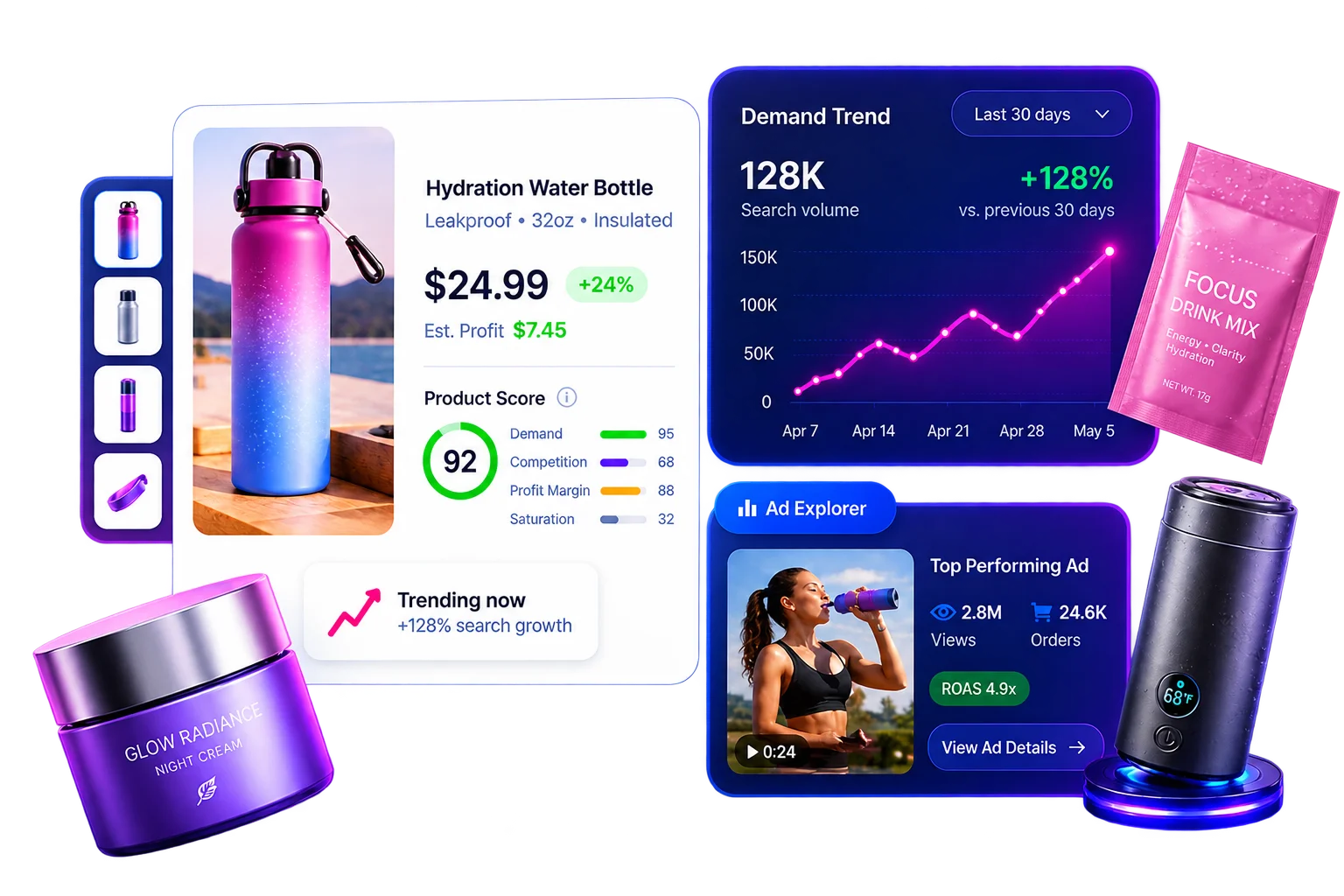
Every tactic above performs better on a design with genuine, durable demand behind it and worse on a design nobody was asking for, which is why understanding what is actually working belongs before content and ad spend, not after. Reviewing how long a competitor's ad creative has stayed active is a useful proxy for durable demand versus a short-lived trend, since Dropmind's Ads Explorer is built to help study active ad creative, messaging, and how long a given angle keeps running, before committing content or ad budget to a new design or niche. For sellers deciding which niches or product themes are worth designing around next, Dropmind's Winning Products surfaces product opportunities that meet its own demand and trend-direction research criteria, a useful starting signal even though it is not a substitute for watching how a specific design actually performs once real customers see it. The same research discipline, covered in more depth in Dropmind's guide to finding winning dropshipping products, applies whether the product is sourced in bulk or printed on demand per order.
For the short-form video tactics covered above, the channel-specific playbook, posting cadence, Stories, ads, and a 30/60/90-day plan, is covered in more depth in Dropmind's Instagram marketing playbook for dropshipping, and the broader marketing sequencing question of which channel to prioritize at which revenue stage is covered store-wide, not just for POD, in Dropmind's dropshipping marketing ideas playbook.
Frequently asked questions
Is Etsy or your own Shopify store better for a print on demand business?
Etsy and similar marketplaces are usually the faster way to get a brand-new store's first sales, since they hand you existing buyer traffic in exchange for a meaningful cut of every sale and less control over pricing and the customer relationship. A self-hosted store on a platform like Shopify keeps more of each sale and full control over pricing and email, but you supply all the traffic yourself. Many sellers start on a marketplace to validate designs, then move proven ones to their own store as volume grows.
How much of a print on demand sale actually goes to fees before you see profit?
It depends heavily on the platform. Etsy's listing, transaction, and payment-processing fees together run roughly 10% to 12% of a typical sale before the supplier's base production cost is even subtracted. Redbubble and TeePublic use a margin or flat-royalty model instead of a percentage fee, so the "fee" shows up as a lower per-item payout rather than a percentage line item, which makes direct comparison across platforms less straightforward than it first appears.
Do you need FTC disclosure for a print on demand giveaway or influencer post?
Yes for any paid or gifted influencer partnership, the FTC's Endorsement Guides require a clear, conspicuous disclosure of the material connection placed with the claim itself. A giveaway is a separate compliance question governed more by sweepstakes law and, on Meta platforms, Instagram and Facebook's own promotion guidelines, both of which require a "no purchase necessary" option and official rules regardless of whether an influencer is involved.
How much should a new POD store spend on paid ads before it has any organic traction?
Many sellers hold paid ad spend near zero until a design shows real pull through free channels, a marketplace sale streak or organic content that earns saves and shares, since ads tend to amplify existing demand rather than create demand from a design nobody has responded to yet. Once that signal exists, a starting budget in the $10 to $30 a day per ad set range is a common way to test paid social without overcommitting to an unproven creative.
What is the fastest way to get a print on demand design in front of new customers with no budget?
Short-form video built around a design that already shows some independent interest, combined with listing that same design on an established marketplace like Etsy, Redbubble, or TeePublic, covers the two channels most likely to produce sales without any ad spend. Both lean on an audience that already exists somewhere else instead of requiring you to build one from scratch first.
The bottom line
A print on demand store does not need every tactic in this guide running at once, and trying to run all ten simultaneously is itself one of the more common ways a small team's marketing effort gets wasted. Start by getting a design in front of real buyers cheaply, a marketplace listing, short-form content, or both, before spending anything on ads or tools built for a scale you have not reached yet. Layer in paid social and email once a design proves it has genuine pull, and treat giveaways, discounts, and influencer partnerships as tools with real rules attached rather than free wins. The stores that keep growing past their first few designs are rarely the ones running every tactic on this list. They are the ones who found out which designs people actually wanted before they spent seriously on promoting them.