
Table of Contents (23 sections)
Dropshipping Marketing Ideas for 2026: A Playbook Ranked by Effort and Payoff
Most marketing advice aimed at small businesses assumes you have something dropshipping stores usually do not: a physical location, a local customer base, or a product people already trust because they can see it in a shop window. A dropshipping store is almost always the opposite case. It is marketing an unproven product to a cold, entirely online audience, with a business owner who is also doing customer service, supplier vetting, and product research in the same afternoon.
That difference changes which tactics are worth your time. Generic small-business guides lead with local search optimization and community sponsorships. A dropshipping store gets far more out of channels built for cold discovery and repeat-purchase automation, paired with the same product-validation discipline that separates a profitable ad account from a wasted one.
Quick answer
For a dropshipping store in 2026, the highest-leverage marketing mix is short-form video for cold discovery, email and SMS automation for the customers you already have, and Meta or Google ads to scale whatever the organic content and competitor research already suggest is working. Free or low-cost tactics, mainly organic content, email flows, and a review-collection habit, can carry a store through its first $5,000 to $10,000 a month. Paid channels earn their place once there is a validated product and creative to put budget behind, not before.
Why generic small-business marketing advice only partly fits a dropshipping store
A lot of small-business marketing content centers on local SEO: claiming a Google Business Profile, building location pages, getting mentioned in a neighborhood Facebook group. None of that is wrong advice. It is simply built for a business with a storefront, a service area, or a name people already search for by location. A dropshipping store selling a phone accessory or a kitchen gadget to a national or international audience has no location to optimize around, so that entire category of tactics contributes little.
What actually applies is the harder problem underneath the local-SEO advice: earning trust from someone who has never heard of your store, fast enough that they buy before they leave the page. That is a discovery and trust problem, not a location problem, and it is why the tactics below lean toward content that travels to cold audiences, automated messages that build trust with warm ones, and review systems that substitute for the in-person credibility a local business gets for free.
The marketing ideas worth your time in 2026
Short-form video for cold discovery
TikTok, Instagram Reels, and YouTube Shorts remain the main way a dropshipping store reaches people who have never encountered it, since these formats get distributed well beyond a store's existing followers when the opening seconds hold attention. The content that performs is rarely a polished product ad. Unboxings, a five-second framing of the problem the product solves, and genuine reactions tend to outperform commercial-style footage, and none of it requires professional equipment.
The channel-specific playbook, including posting cadence, Stories, ads, and a 30/60/90-day plan, is covered in more depth in Dropmind's Instagram marketing playbook for dropshipping. The short version that applies across every short-form platform: film around products that already show independent demand, not around themes that sound good on a content calendar, since content built on a guess rarely converts as well as content built on a product people are already searching for.
SEO built around buyer intent, not local search
The version of SEO that works for a dropshipping store is blog and product-page content targeting long-tail, buyer-intent phrases, comparison posts like "best [product] for [use case]," gift-guide roundups, and how-to content tied to the products you sell. This kind of content compounds the way paid ads do not: a post that ranks keeps sending free traffic for years, not just for the days a campaign is funded.
A second, often-skipped SEO move specific to product-based businesses is listing products in Google's free Merchant Center shopping listings, which put products in Google Shopping search results without any ad spend, on top of whatever organic blog traffic the store earns separately. Both are slow to build, generally six months or more before search traffic becomes meaningful, but neither requires an ongoing budget once set up.
Email marketing and automated flows
Email remains the highest-ROI channel available to a small store, with Litmus reporting an average return of roughly $36 for every $1 spent (retail and ecommerce brands report higher averages than the cross-industry figure). The advantage that matters most for a dropshipping store specifically is that the list is owned. A platform algorithm change or a paused ad account cannot take it away.
Three automated flows do most of the work: a welcome sequence for new subscribers, an abandoned-cart sequence, and a post-purchase sequence that asks for a review and suggests a complementary product. Set up once, these run continuously and typically account for a meaningful share of total email revenue without a person writing a new email each time. Weekly broadcast emails on top of the automated flows keep the list warm between purchases.
SMS for time-sensitive offers
SMS open rates commonly cited across 2026 industry benchmarks sit in the 95% to 98% range, toward the high end for genuinely opted-in marketing lists, which makes text the right channel for flash sales, limited-stock alerts, and cart-recovery nudges rather than routine updates. The tradeoff is that texting is more tightly regulated than email: under the federal Telephone Consumer Protection Act, a store needs clear, express opt-in consent before sending marketing texts, separate from a general newsletter signup, and violations can carry statutory penalties in the range of $500 to $1,500 per text. Use a dedicated SMS platform that captures and timestamps consent rather than adding phone numbers collected for another purpose to a texting list.
Paid social ads once a product is validated
Meta's Advantage+ Shopping campaigns automate most targeting decisions and are the standard starting point for a dropshipping store's paid social budget, typically in the $10 to $30 per day per ad set range, using organic content that already earned saves and shares as the ad creative rather than commissioning separate footage. Plan on one to two weeks of real spend before judging results, since that is roughly how long the algorithm needs to exit its early learning phase.
The step that separates stores that scale profitably from ones that burn budget is not the ad platform. It is whether the product and angle were validated before spend started. Reviewing how long a competitor's ad creative has stayed active, covered in more detail in the product-research section below, is a useful proxy for durable demand before committing a budget to a new product or angle.
Google Shopping and Search ads for high-intent traffic
Search ads reach people at the moment they are already looking for a product, which makes them a different kind of channel from social ads: less discovery, more capture. For a dropshipping store, Shopping campaigns (which show the product image and price directly in results) generally outperform text-only Search ads for product-based businesses, and both are worth testing with a small budget, commonly $10 to $20 a day to start, once a product has shown it converts through other channels first.
Referral and loyalty programs
A referral program turns existing customers into an acquisition channel that costs less than paid ads on a per-customer basis, since both the referrer and the new customer typically receive a discount or credit rather than the store paying a platform for the click. Tools built into Shopify or WooCommerce, or standalone apps, can set this up in an afternoon. The programs that work are simple enough to explain in one sentence, a specific dollar or percentage credit for both parties, rather than a tiered points system that is confusing to a first-time buyer.
Reviews and social proof
PowerReviews' 2026 consumer survey found that 74% of US online shoppers always check reviews before buying a product priced over $50, and separately found that most shoppers feel comfortable purchasing once a product has somewhere between one and 25 reviews, while a smaller group wants to see several hundred before fully trusting it. The practical implication for a new dropshipping store: getting a product from zero reviews to even a handful matters more than chasing a large volume immediately, and a rating in the roughly 4.0 to 4.7 star range tends to convert best, since a perfect 5.0 with few reviews can read as unreliable to a skeptical shopper.
Automate the ask with a post-purchase email or SMS a few days after delivery, and make leaving a review a one-click action from that message rather than a multi-step process on the store itself.
Repurpose one piece of content across every channel
Creating separate content for TikTok, Instagram, email, and the blog from scratch each week is not sustainable for a one- or two-person team. Building around a single core asset, an unboxing video, for example, and reshaping it into a short clip, a blog write-up, and a talking point for the next email, keeps output consistent without the workload of five separate content plans. Consistency across channels is what compounds into an audience over time, more reliably than any single piece that happens to go viral.
Choosing your mix by store stage
| Stage | Recommended focus | What to hold off on |
|---|---|---|
| Pre-launch to first sales | Organic short-form video around validated products, welcome and abandoned-cart email flows, Google Merchant Center free listings | Paid ads. Validate the product and angle organically first |
| $0 to $5,000/month | Add SMS for flash sales, a referral program, and a systematic review-collection flow | Running more than one paid channel at once; get one working before adding a second |
| $5,000 to $20,000/month | Meta Advantage+ ads using proven organic creative, Google Shopping for high-intent traffic, blog SEO content compounding in the background | Treating ad spend as separate from product research; keep validating new products before advertising them |
| $20,000+/month | Content repurposing systems across every channel, expanded creator or UGC partnerships, budget of roughly 10-15% of revenue split across proven channels | Concentration in a single ad account or channel; diversify before one platform change can stall growth |
Staying compliant while you market
This section reflects the FTC's Consumer Review Rule and Endorsement Guides, the CAN-SPAM Act, and the federal Telephone Consumer Protection Act as reviewed on August 10, 2026, and applies to marketing reaching consumers in the United States. Sellers marketing to other countries should confirm the applicable rules in each jurisdiction. This is general educational information, not legal advice.
The FTC's Consumer Review Rule, which took effect in October 2024, prohibits buying, writing, or incentivizing fake reviews and testimonials. The FTC spent its first year focused on guidance, but shifted to active enforcement starting in December 2025, issuing warning letters and stating that violations can carry civil penalties of roughly $53,000 per violation. Collecting genuine reviews through an automated post-purchase ask, the approach described above, stays entirely clear of this rule. Paying for reviews, swapping free products for guaranteed positive ratings, or posting reviews from a second account does not.
If you work with creators or influencers, the FTC's Endorsement Guides require a clear, conspicuous disclosure of any material connection, a paid partnership, a free product, or an affiliate relationship, placed with the claim itself rather than buried in a hashtag block. Using the platform's built-in paid-partnership label satisfies this in most cases.
For email, the CAN-SPAM Act requires an accurate sender name, a working unsubscribe link honored promptly, and no misleading subject lines. For SMS, the Telephone Consumer Protection Act requires clear, express consent captured before you text anyone for marketing purposes, separate from an email opt-in. Both are worth building into your platform setup from day one rather than treating as an afterthought once a list exists.
Common mistakes that waste a dropshipping marketing budget
- Running paid ads before a product has shown any organic pull. Ads amplify existing demand; they rarely create it from nothing.
- Copying a competitor's ad creative because it has run for weeks, instead of treating that longevity as a signal for what angle to test rather than a script to clone outright.
- Spreading effort across every channel in this guide at once instead of getting two or three working well first.
- Skipping the review-collection flow until a negative review appears, instead of building a steady base of reviews from the first sale onward.
- Sending SMS to a list collected for another purpose without separate, documented consent, which risks both regulatory exposure and a spike in opt-outs.
Where product research fits before you spend on marketing
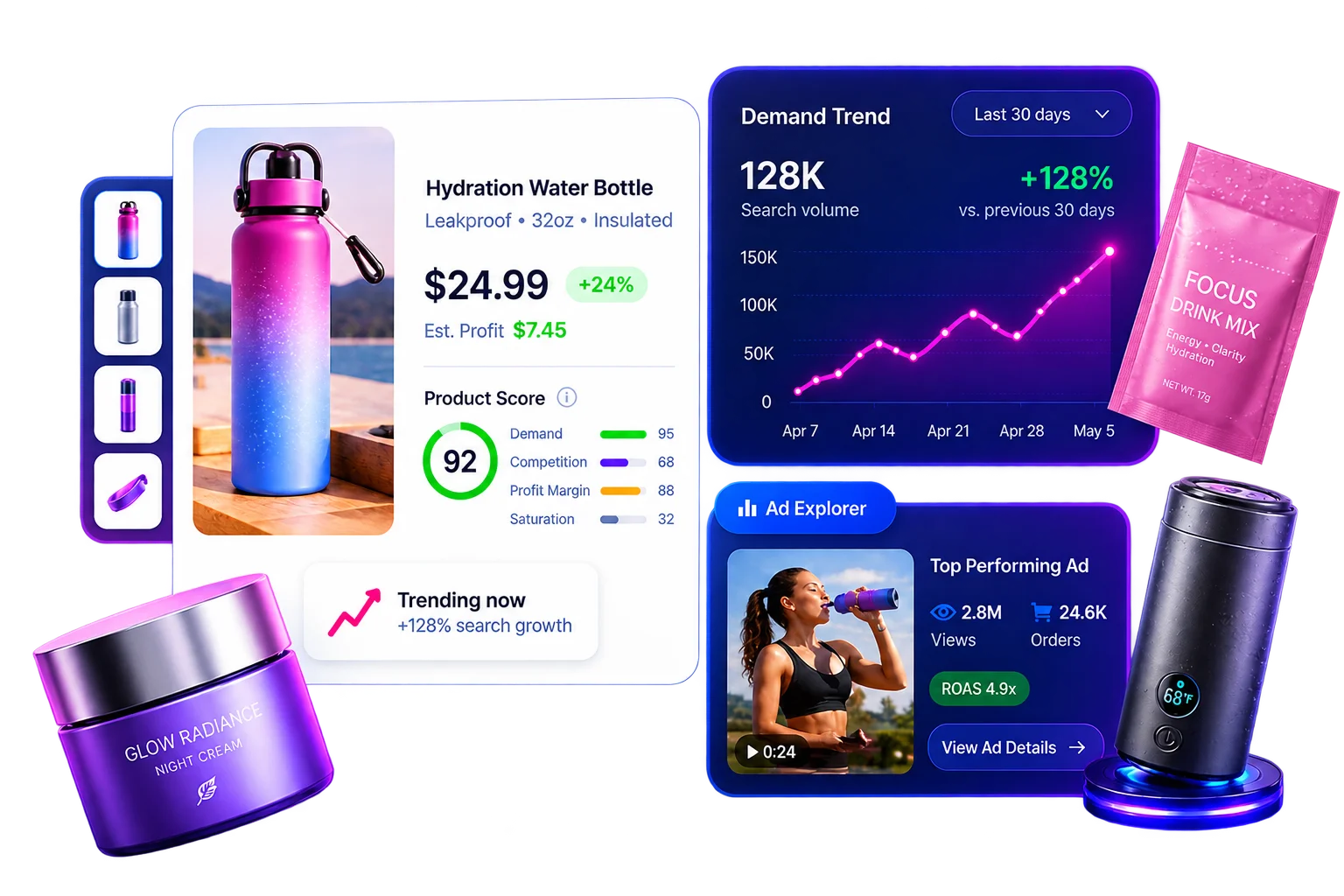
Every tactic in this guide performs better on a product with real, durable demand behind it and worse on a product with none, which is why product research belongs before content and ad planning, not after. A short-lived trend that spikes and fades within weeks tends to produce a burst of content views and orders followed by a drop-off that no amount of marketing effort reverses. Dropmind's Winning Products research and Ads Explorer are built to help evaluate a product's demand durability and existing competitive activity before a store commits content or ad budget to it, which is the same discipline covered in more depth in Dropmind's guide to finding winning dropshipping products. As with any research tool, it is a starting point for validation, not a replacement for watching how a specific product actually performs once it is live. For stores just getting their storefront and supplier relationships in place, the complete Shopify dropshipping guide covers that groundwork in full.
Frequently asked questions
What is the best marketing strategy for a new dropshipping store with no budget?
Short-form video content built around a validated product, combined with an email welcome and abandoned-cart flow, costs nothing beyond time and covers the two channels most likely to produce early sales. Add a referral program and a review-collection habit once the first handful of orders come in.
How much should a dropshipping store spend on marketing?
Many stores past the early validation stage budget roughly 10% to 15% of revenue toward marketing, split across proven channels rather than spread evenly across everything in this guide. Earlier-stage stores often spend closer to zero in cash and more in time, leaning on organic content and email until a product is validated enough to justify ad spend.
Should a dropshipping store run ads before it has any organic traction?
Generally no. Ads tend to amplify whatever is already true about a product's demand rather than create demand from nothing, so a product with no organic pull usually performs the same, expensively, once ads are turned on. Validating a product and angle organically first makes every dollar of ad spend after that more efficient.
Is SMS marketing worth the compliance overhead for a small dropshipping store?
Often yes, for time-sensitive offers specifically, given open rates that regularly exceed email. The compliance step, capturing clear and separate consent under the Telephone Consumer Protection Act, takes an afternoon to set up correctly through a dedicated SMS platform and then runs automatically, so it is a one-time cost rather than an ongoing burden.
How many reviews does a new product need before it starts converting well?
Research from PowerReviews suggests most shoppers feel comfortable buying once a product has somewhere between one and 25 reviews, which is a lower bar than many new sellers assume. A steady post-purchase review request is usually enough to clear that threshold within the first few dozen orders.
The bottom line
A dropshipping store does not need every tactic in this guide running at once, and trying to run all of them simultaneously is itself one of the more common ways marketing effort gets wasted. Start with short-form content around a validated product and an email flow that runs itself, add SMS and a referral program once the first sales land, and layer in paid ads once organic content and competitor research both point toward a specific product and angle worth funding. The stores that keep growing past their first few months are rarely the ones with the longest tactic list. They are the ones who validated demand before they spent on it, then built systems, not one-off campaigns, around whatever proved out.