Table of Contents (20 sections)
Instagram Marketing for Dropshipping in 2026: A Data-Driven Playbook
Instagram still works for dropshipping in 2026, but "post more Reels" stopped being a strategy on its own a while ago. It is a starting point. The stores that keep growing use Instagram as the front end of a system that starts with a validated product, uses Reels and Stories to build proof, and uses ads and competitor research to scale whatever is already converting. Content without product validation, and ad spend without any read on what competitors are already running, are the two most common reasons dropshippers burn through a marketing budget with little to show for it.
This guide covers what actually matters for a dropshipping store running Instagram in 2026, and where generic Instagram advice, including a lot of what gets published on the topic, tends to skip the step that determines whether any of it converts.
Quick answer
Instagram marketing works for dropshipping when a store treats it as a system rather than a content calendar: validate that a product already has demand, use Reels for cold-audience discovery, use Stories and a clean Shop presence to build trust with warm traffic, and use paid ads (typically starting around $10 to $30 per day per ad set on Meta's Advantage+ Shopping campaigns) to scale whatever the organic content and competitor research already suggest is working. Posting volume matters less than most guides imply. Product and creative validation matter more.
Why generic Instagram advice underperforms for dropshipping specifically
Most Instagram marketing content is written for creators and local businesses selling something they already know people want. Dropshipping is different in one important way: a store is often testing an unproven product against an audience that has never heard of it. That changes the order of operations.
A creator can post inconsistent content for months and still build an audience, because the "product" is their personality. A dropshipping store does not have that luxury. If the product itself has no real demand, meaning nobody is searching for it, no competitor is running sustained ads on it, and the category shows no independent momentum, then content discipline alone will not fix that. A store can generate views without generating orders.
This is the practical gap between generic Instagram advice and an approach built for dropshipping: validate the product and the angle first, using signals that exist independently of your own marketing, then use Instagram's content and ad tools to execute against something that already has a pulse. Jumping straight to content calendars and hook libraries is a common way stores end up with reasonable engagement and few actual sales.
The Instagram channels that matter for a dropshipping store
Instagram is not one feed. It behaves as five distinct surfaces, and each plays a different role in a dropshipping funnel. Treating them identically wastes content.
Reels: cold-audience discovery
Reels are shown to non-followers largely based on watch time and rewatch rate, which makes them the main organic format capable of reaching people who have never encountered a store before. Instagram's own leadership has publicly described watch time, likes-per-reach, and sends-per-reach as central ranking signals for the platform, with sends carrying particular weight for reaching audiences beyond a store's existing followers. For a dropshipping brand, the Reels that tend to perform are rarely polished product ads. Short, native-feeling clips, such as unboxings, a five-second framing of the problem a product solves, a before-and-after, or a genuine customer reaction, tend to hold attention better than commercial-style footage. The opening few seconds still gate distribution: if the hook does not stop the scroll, the algorithm never receives the watch-time signal needed to extend the video's reach.
Stories: the trust layer for an existing audience
Stories rarely reach new people, but they tend to convert warm traffic more effectively than most other formats, because the viewer has already opted in. For dropshipping specifically, Stories are a practical way to close the trust gap that a product page alone often cannot: showing orders being packed, answering product questions on camera, being direct about realistic delivery timelines, and using product stickers so that a Story can be shopped without leaving the app.
Feed and the Shop tab: the credibility check
When someone taps through from a Reel, the grid and Shop tab are what decide whether they follow, browse, or leave. A feed of low-effort reposts can undercut conversion even when the Reel that brought the visitor there performed well. One clean, well-lit image per bestseller, tagged for shopping, generally does more for conversion than another week of quote graphics or reposted memes.
Instagram ads: where a validated product scales
Meta's Advantage+ Shopping campaigns automate most targeting decisions, and several performance marketing agencies have reported lower cost-per-purchase from Advantage+ campaigns compared with manually targeted setups for smaller advertisers, though the exact improvement varies by source and account. A practical starting point many marketers recommend is $10 to $30 per day per ad set, using existing organic Reels as ad creative rather than commissioning separate polished footage, and allowing one to two weeks of real spend before judging results, since that is roughly how long the algorithm needs to exit its early learning phase.
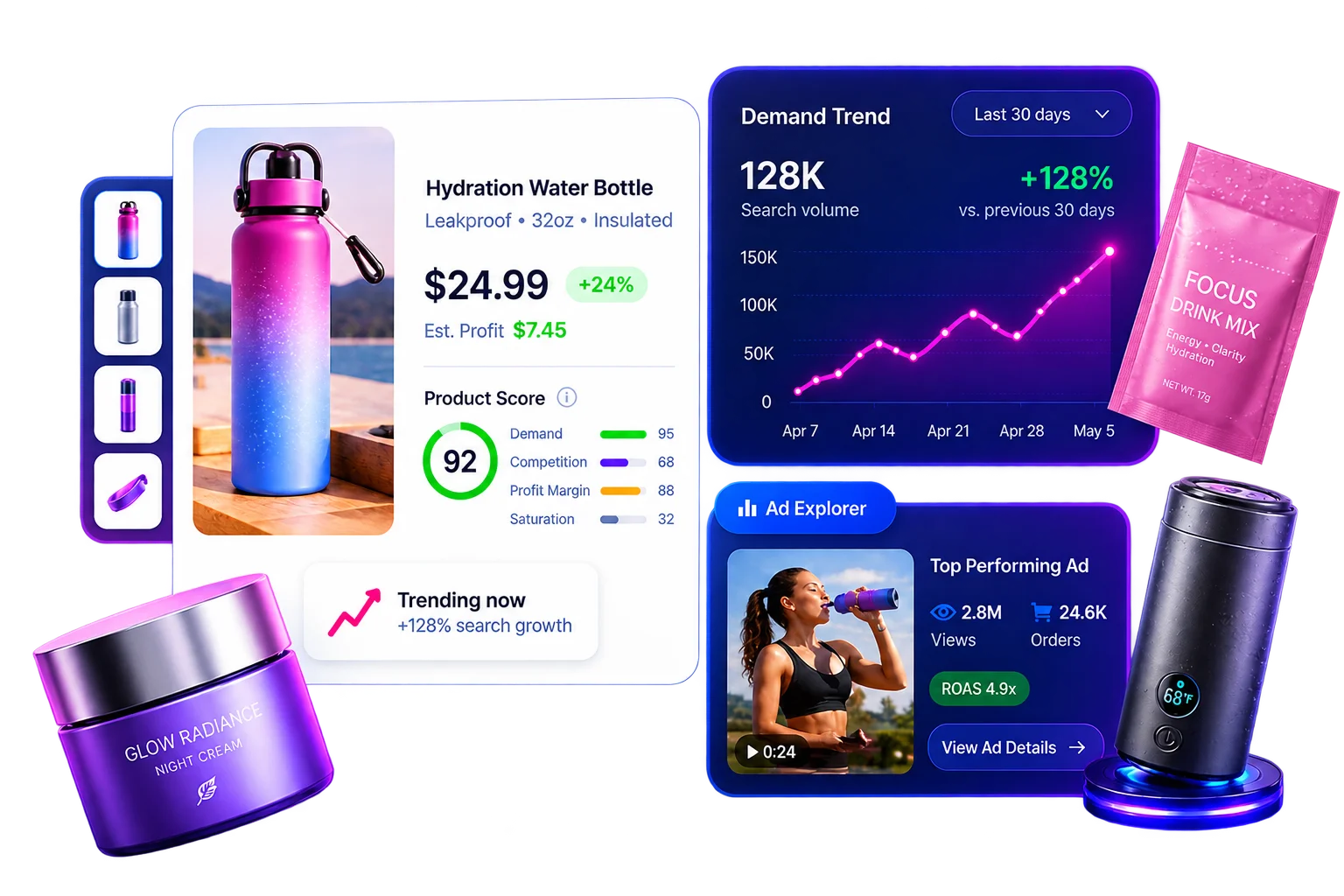
The step many stores skip here is not budget. It is visibility into what similar stores are already running. An advertisement that has stayed active for several weeks is a stronger demand signal than a guess, because advertisers rarely keep paying for creative that consistently loses money. Reviewing that kind of advertising activity is one of the things Ads Explorer is built for: studying active creatives, how long they have run, messaging patterns, and landing-page destinations, so a store can form a view of what the market is already responding to before committing ad spend to a new product or angle. As with any research signal, ad longevity supports a hypothesis. It does not prove profitability on its own, so it is worth reviewing alongside engagement quality, pricing, and competition.
DMs and comments: the closer
The inbox remains one of the more underused parts of Instagram for small stores. A genuine reply to a product question, especially a short voice note, can close a sale that a static product page could not, because it removes some of the doubt a stranger has about a store they have never bought from. Pinning a comment with a product link on a Reel that is gaining traction is a small habit that can meaningfully increase click-through with little extra effort.
Building content around validated products, not content pillars
Common advice says to pick three content pillars and batch content around them. That is not wrong, but for a dropshipping store it can put the content before the evidence. Pillars work better when they are built around what a store already has reason to believe will perform, not around themes that sound good in a content calendar template.
A more useful sequence for dropshipping looks like this. Start from product signals rather than content ideas: look at what shows sustained demand, such as search interest, competitor ad longevity, and category momentum, before deciding what to film. A product already showing independent demand gives a store a natural hook. An unvalidated one requires manufacturing interest from nothing. From there, batch production around the two or three products with the strongest signals, rather than around abstract themes like "tips" or "behind the scenes," so every Reel is doing double duty: building the brand and testing whether that specific product resonates. Treat every organic Reel as a low-cost creative test, since save rate and share rate are a useful, free signal for what is worth turning into a paid ad. Reviewing product-level demand signals before committing content resources is the same discipline covered in more depth in Dropmind's guide to finding winning dropshipping products, which applies directly here: content built around a product with real demand behind it has a real advantage over content built around a guess.
Posting four to six Reels a week is a reasonable volume target, roughly what the algorithm needs to build a usable signal on an account, but posting more content without validating the underlying product mostly produces more content that does not convert any faster.
Instagram growth tactics worth the time in 2026
A few tactics consistently outperform generic "grow your following" advice for stores right now.
- Collabs with adjacent accounts. Instagram's native Collab feature publishes one Reel to both accounts' audiences at once and keeps it live on both profiles. Pairing with an account one to three times a store's size tends to outperform paid shoutouts, because the reach compounds instead of expiring after a day.
- Searchable profiles and captions. Instagram indexes bios and captions for its own in-app search, so a bio that names a niche and offer directly, such as "Home organization tools, ships in 3 to 5 days," is more discoverable through search than a vague but clever bio.
- Reply-Reels on trending content in a niche. Stitching a response onto a well-performing Reel in a relevant category can inherit some of that video's audience signal, and done thoughtfully it often outperforms a cold original post.
- Hashtags used for categorization, not reach. Three to five relevant hashtags help Instagram file content correctly. Beyond that, hashtag volume has little measurable effect on 2026 reach and can make a post look lower-effort to a viewer scanning for credibility.
What no longer works, despite still circulating as advice, includes engagement pods, follow-unfollow tactics, and purchased followers. Meta periodically removes bulk-purchased followers in cleanup sweeps, and an inflated, low-quality audience can drag down the engagement rate the algorithm uses to decide who else should see an account's content.
Common mistakes dropshipping stores make on Instagram
- Running ads before validating the product. Ads amplify whatever is already true. If a product has no organic pull, ads tend to make that clear faster and more expensively. They rarely create demand from nothing.
- Sending traffic to a slow or generic store. A Reel that stops the scroll is largely wasted if the linked product page is slow to load, uses stock photography, or gives a visitor little reason to trust the store. Instagram can earn the click. The store still has to earn the sale.
- Copying competitor creative instead of studying why it works. Seeing a competitor run the same ad for six weeks is a signal that the offer and hook are working. It is not a guarantee that copying the exact video will produce the same result. It is more useful as a signal for what angle to test than a script to clone.
- Judging results after two or three days. Organic Reels and Advantage+ campaigns generally need one to two weeks of real data before the algorithm has enough signal to optimize. Ending a test on day three often means judging a system that has not finished learning yet.
- Ignoring the DM and comment backlog. An unanswered product question is a lost sale and a missed piece of content research, since the questions that come up repeatedly are often the FAQ and content ideas a store has not written yet.
A 30/60/90-day plan for a dropshipping store
Days 1 through 30 are for validation and building an initial signal. Confirm demand on the two or three strongest product candidates using search trends and competitor ad activity before committing content resources. Post four to six Reels a week built around those products, reply to every DM and comment, and hold off on paid ads until specific Reels are earning saves and shares organically.
Days 31 through 60 are for adding Stories discipline and a first ad test. Add three to five Stories a day using product and link stickers. Take the best-performing organic Reel and put roughly $10 to $20 a day behind it in an Advantage+ Shopping campaign. Start tracking which creative angles competitors are still running versus which ones they appear to have dropped, since a dropped ad after a short run is closer to a signal to avoid that angle than to copy it.
Days 61 through 90 are for scaling what is working and cutting what is not. Increase budget on ad sets with an acceptable cost per result, consider a Collab with an adjacent account, and retarget people who viewed a product without buying. A low daily retargeting budget on warm viewers commonly delivers a stronger return than cold traffic. By day 90, a store should be able to point to specific Reels, ads, and products that are working, rather than a general sense that engagement is trending up.
Staying compliant on Instagram
This section reflects the FTC's Endorsement Guides and related guidance as reviewed on August 9, 2026, and applies to advertising and endorsements reaching consumers in the United States. Other countries have their own advertising-disclosure rules, so sellers marketing outside the US should confirm the applicable requirements in each relevant jurisdiction. This is general educational information, not legal advice.
The FTC's Endorsement Guides require clear and conspicuous disclosure whenever there is a material connection, such as a paid partnership, a free product, or an affiliate relationship, between a brand and whoever is promoting it. In practice, that means using Instagram's built-in Paid Partnership label placed with the claim itself, not buried in a block of hashtags or left in an About section. Vague tags such as #collab or #ambassador do not meet that standard on their own. Noncompliance can carry meaningful civil penalties, so this is worth treating as a real requirement rather than a suggestion, and the exact current penalty framework is best confirmed directly on ftc.gov rather than assumed from older figures.
On the platform side, purchased followers, bot engagement, and fake giveaways remain among the fastest ways to get an account suppressed. Meta's periodic cleanup sweeps remove bulk-purchased followers, which lowers both the follower count and the engagement rate at the same time. Product claims also need to stay defensible: language such as "may help with X" is generally fine, while "guaranteed to cure X" invites both platform action and regulatory attention. None of this is exciting guidance, but it is a meaningful part of the difference between a store still running in eighteen months and one that loses its account overnight.
Frequently asked questions
How is Instagram marketing for dropshipping different from Instagram marketing for a personal brand?
A personal brand can build an audience around personality alone and decide what to sell later. A dropshipping store is usually testing a specific, unproven product against a cold audience, which means validating real demand for that product, through search trends, competitor ad longevity, or category signals, generally needs to happen before content strategy rather than after it.
How much should a dropshipping store budget for Instagram ads in 2026?
Many marketers suggest starting around $10 to $30 per day per ad set using Advantage+ Shopping campaigns, which automate most of the targeting. Plan for at least one to two weeks before judging a test, since that is roughly how long the algorithm needs to exit its early learning phase and optimize properly.
Do hashtags still matter for Instagram growth in 2026?
Not much for reach. Three to five relevant hashtags help Instagram categorize content correctly, but hashtag volume beyond that has little measurable effect on how far a post travels in 2026, and a large hashtag block can make a post look lower-effort to viewers scanning for credibility.
What is the fastest way to know if a product is worth building Instagram content around?
Check whether the product already shows demand signals that exist independently of a store's own marketing, such as sustained competitor ad activity, rising search or trend interest, and category momentum. Reviewing tools built for this kind of product and advertising research, including Dropmind's Winning Products shortlist and Ads Explorer, can surface these signals before content or ad spend is committed, rather than after weeks of posting with no clear read on demand.
How long does it typically take to see results from Instagram marketing for a dropshipping store?
Many stores see early engagement signals, such as saves, shares, and watch time, within two to three weeks of consistent posting, with more meaningful sales traction often showing up around the 60 to 90 day mark if the underlying product has real demand. Paid ads on an already-validated product and creative can sometimes shorten that window to two to four weeks, though results vary by niche, budget, and execution.
Conclusion
Instagram in 2026 still rewards the same fundamentals it always has: clear hooks, consistent posting, and genuine engagement. For dropshipping stores specifically, the leverage point has shifted upstream. The stores growing fastest right now are generally not the ones with the most creative hook library. They tend to be the ones who have a read on which products and angles already show market pull before filming a single Reel. Content and ads are the execution layer. Product and advertising research are what indicate which parts are worth executing in the first place.
This article is provided for general educational purposes. Platform features, algorithm behavior, and advertising costs referenced here can change, and results vary by niche, budget, and execution. Confirm current details directly on Meta's official documentation before making a budgeting or compliance decision.